
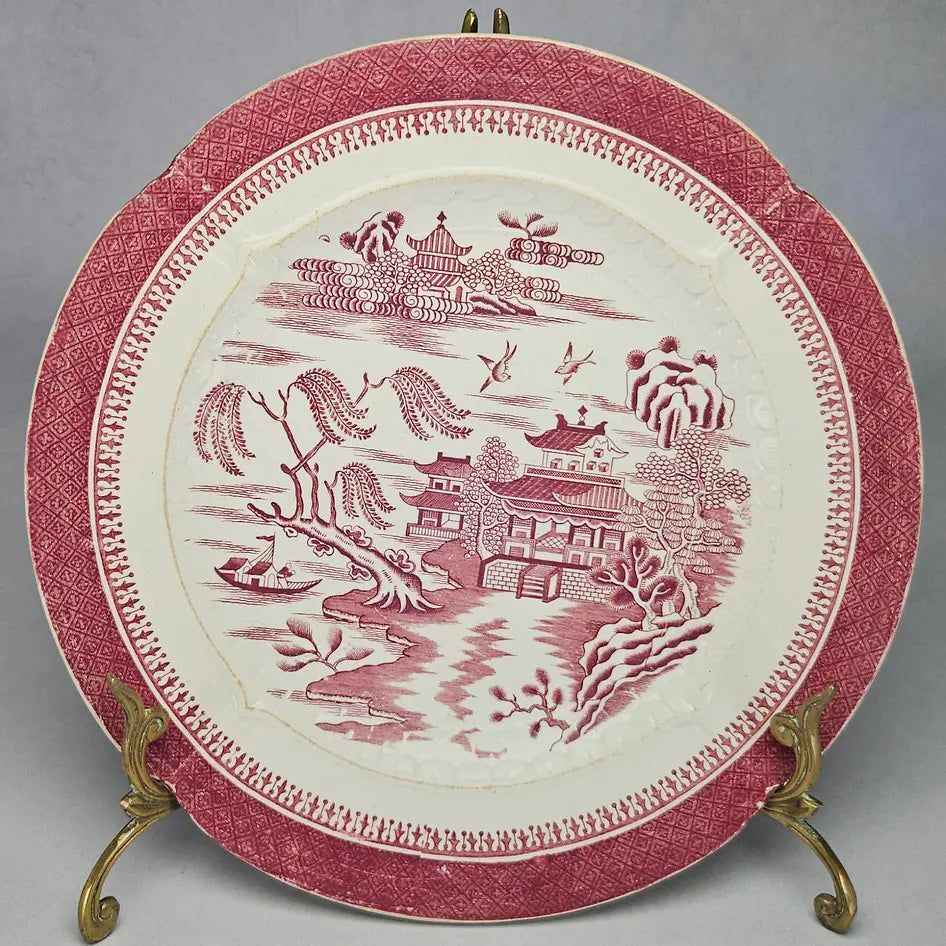
Red Willow is one of the less commonly encountered variants of the Blue Willow pattern, and for that reason one of the more interesting pieces for collectors who enjoy the transferware tradition. Where Blue Willow was produced in enormous quantities by dozens of Staffordshire manufacturers from the late eighteenth century onward, Red Willow was produced in far smaller numbers, making a well-marked example from a documented maker a genuinely distinctive find.
The Willow Pattern and Its Colour Variants
The Blue Willow pattern is one of the most widely produced ceramic designs in the history of English pottery. Based loosely on Chinese landscape motifs, it features a willow tree, a bridge, a pagoda, and two birds, arranged in a composition that became standardised across dozens of manufacturers. The pattern was printed in underglaze blue on white earthenware, and its combination of affordability and decorative appeal made it a staple of English domestic ceramics from the late eighteenth century through the twentieth.
Colour variants of the Willow pattern, including red, green, brown, and mulberry, were produced by a smaller number of manufacturers and in considerably smaller quantities. Red Willow uses the same engraved design as Blue Willow but prints it in a warm iron red rather than cobalt blue. The effect is striking and quite different from the familiar blue version, with the red palette giving the pattern a warmer, more unusual character.
W.T. Copeland and Sons
W.T. Copeland and Sons was the trading name of the Spode factory from 1847 to 1970, following the acquisition of the original Spode business by William Taylor Copeland. The factory continued to produce many of the Spode patterns under the Copeland name, including transferware in the Willow tradition. A piece marked W.T. Copeland and Sons can be dated to the period between 1847 and 1970, with the specific style of the backstamp providing further dating guidance.
The Red Willow Plate in the Collection
The W.T. Copeland and Sons Red Willow Chinoiserie Transferware Plate in the Collectibles by Deon collection is a documented example of this less common variant. The W.T. Copeland and Sons mark on the base confirms the factory origin and places the piece within the Copeland period of production. The red transfer print is clear and well-defined, with the characteristic Willow pattern composition rendered in the warm iron red that distinguishes this variant from the standard blue version.
What to Look For
When assessing a Red Willow piece, look for the following: the mark, as a clear W.T. Copeland and Sons mark adds important identification value and helps place the piece within the Copeland period; the transfer print, looking for crisp detail in the central design, good balance in the border, and an even colour tone across the plate; and condition, examining the rim, surface, foot rim, and reverse carefully, as age-related wear, crazing, staining, chips, cracks, or restoration all form part of the full condition picture.
Collecting Red Willow
Red Willow is actively sought by collectors who specialise in colour variants of the Willow pattern, and by collectors of Copeland and Spode transferware more broadly. Because it was produced in smaller quantities than Blue Willow, good condition examples with clear marks are less commonly encountered and worth seeking out. A Red Willow piece pairs well with Blue Willow in a mixed transferware display, where the contrast between the two colour variants creates an interesting visual comparison.
Browse the Blues and Whites collection and the Ceramics collection at Collectibles by Deon for related transferware pieces, or explore the latest additions to see what has recently come in. For questions about specific patterns or makers, visit our contact page or learn more about the store.
Reading the Mark and the Pattern
Transferware collectors learn to treat the backstamp as part of the object rather than as an afterthought. A clear W.T. Copeland and Sons mark gives the plate a useful starting point, while the exact form of the mark may help narrow the period of production. The mark should be considered alongside the quality of the print, the shape of the rim, the body colour, and any signs of later alteration.
The Red Willow colourway is particularly attractive because it changes the mood of the familiar pattern. The warm red print works well with dark timber, cream pottery, and other Staffordshire pieces, and it can sit comfortably in a display that includes both blue and red transferware. Collectors may choose to focus on one maker, one colour family, or several interpretations of the Willow design.
Condition in Transferware
Inspect the rim for small nibbles, the centre for scratches or staining, and the foot rim for old repairs. Crazing is common in older earthenware, but deep staining, hairline cracks, or a repaired break should be recorded clearly. A plate that has been used can still be decorative and collectable when its condition is honestly understood.