If you've ever picked up a charming small green rabbit with a knowing tilt of the head and felt intrigued by it, you've likely met SylvaC. Few English potteries inspire the kind of affectionate, slightly obsessive collecting that SylvaC does, and once you know a little of its history, it's easy to see why. This guide is the first maker profile in our Classic English Pottery Makers collector's series.
Who Were SylvaC?
SylvaC began life in 1894 as Shaw and Copestake, a pottery founded by William Shaw and his uncle William Copestake at the Drury Works on Normacot Road in Longton, Stoke-on-Trent, the same Staffordshire town that later gave the world Beswick. Copestake retired only a few years in, but the Shaw family stayed at the helm for the rest of the company's life, with Richard Hull joining as a partner and his son, Richard Hull Jr., taking over after him. The factory kept producing until May 1982, when it went into voluntary liquidation, bringing to a close nearly 90 years of production from the same corner of Longton.
Where the Name Comes From
The trade name "SylvaC", the mark most collectors know the pottery by today, was registered in the late 1930s, well after the company itself was founded. Early ware left the factory largely unmarked, with an impressed "SILVO" stamp appearing on some pieces through the 1920s, before a daisy-shaped printed mark took over from around 1925 to 1937. It's the SylvaC name, alongside the pottery's now-famous matt glaze, that built the brand's identity from the 1930s onward.
The Ranges Collectors Look For

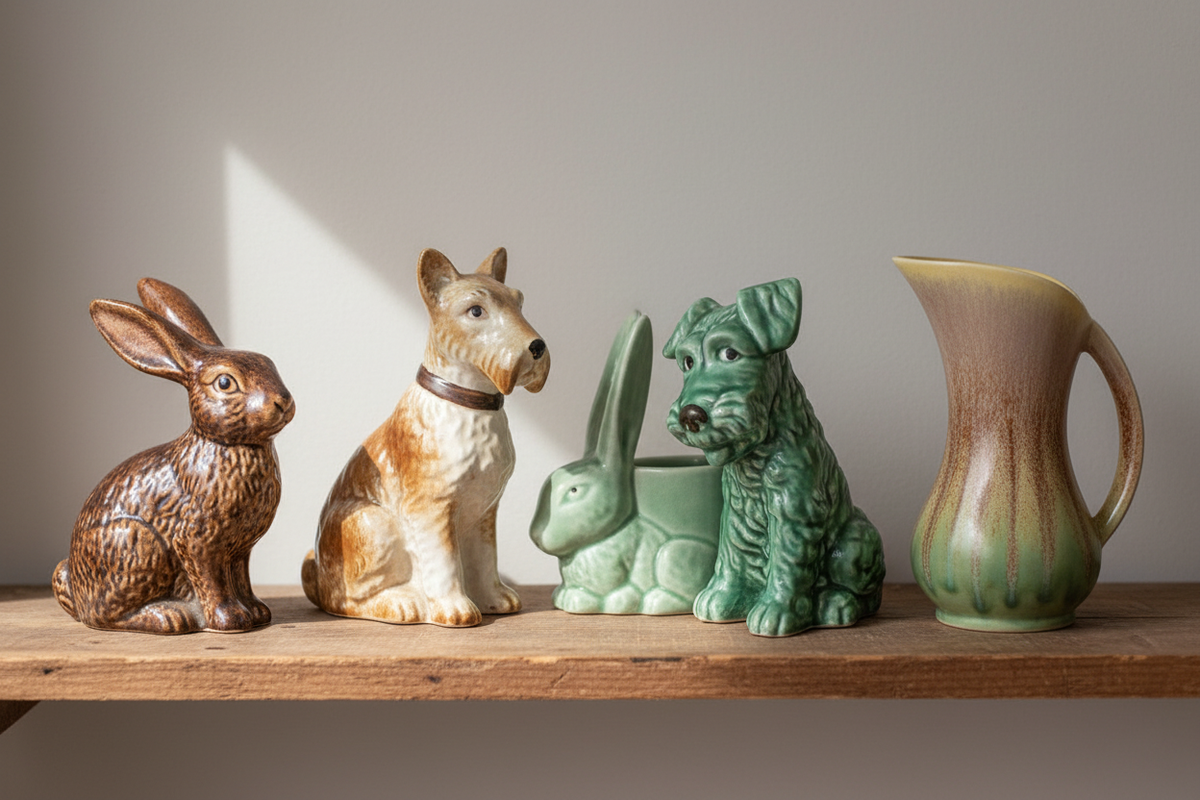
SylvaC's reputation rests almost entirely on its animal figures, and the story behind them is part of the charm. When rabbits were first proposed in the 1930s, company management was not sold on the idea evident by the "No one is going to buy green rabbits" line that was used as part of their marketing campaign. But they were proved wrong! Rabbits stayed in continuous production until 1975, across every colourway and glaze the factory offered, and remain one of the most instantly recognisable SylvaC shapes.

Dogs, and terriers in particular, were just as important. The Scottie terrier became something of a house signature, appearing again and again across different sizes, poses and glazes over more than four decades of production (1939 to 1982). Beyond the animals, SylvaC is also known for its posy ware and flower vases, character jugs (including a run of Shakespeare-themed designs through the 1960s and into 1975), the deer-led Woodland Range produced from the 1960s until closure, and Teddy and Zooline nursery ware aimed at the children's gift market.
How to Date and Identify a Genuine SylvaC Piece
Because SylvaC produced continuously for close to 90 years, marks are the best dating tool. Pieces made before around 1925 are largely unmarked, or carry an impressed "SILVO" stamp. From roughly 1925 to 1937, a printed daisy-shaped mark was used. From the early 1940s onward, impressed marks became standard, typically including the shape number. From 1946, printed paper labels were introduced, evolving over the following decades into a distinctive top-hatted figure formed from the letters "S" and "C", used from the 1960s onward.

Shape numbers, impressed into the base alongside the mark, are one of the most useful things to check. Published references place 1930s shapes roughly in the 700s to mid-1100s range, and 1940s shapes from about 1500 to 1683, which can help narrow a piece to within a decade even where a printed label has worn away. Again, this is a general guide rather than an exact rule, since labels are known to have carried over onto later reissues of the same shape.
The SylvaC Glaze Palette
SylvaC's signature matt finish, introduced in the 1930s, is most often seen in blue, green, brown and ivory, alongside mottled gradient glazes such as green-to-fawn and pale green-to-blue. Rarer colours tend to command more collector interest than the common green and brown.
What to Look For When Buying SylvaC
When purchasing SylvaC, check ears, tails, paws and any upright details first, since these are the most common places for chips or old repairs on an animal figure. Fine surface crazing is common on vintage matt glazes and not necessarily a fault, but heavy crazing or glaze loss will affect condition. A crisp, legible impressed shape number is generally a good sign of a well-preserved piece.
Pieces Currently in Our Collection
Bunny lovers are especially well looked after this round: Harry the Hare stands guard over his own posy holder, and a pair of rabbits caught mid-kiss make an equally sweet find. Dog people (man's best friend, after all) will want to head straight for the Scottie terrier lineup, from a jaunty tan Mac Scottie to a softer grey seated version. And if your taste runs a little sillier, don't miss the cat-and-dog top hat piece, a puppy tumbling out of a tiny green shoe, or the very dignified elephant with his trunk raised skyward.
There's a handful of jugs and posy vases in the mix too, for anyone building a tablescape rather than a shelf of characters.
Have a browse through the Shop SylvaC Collection to see what's still up for grabs.
Why This Maker Is Worth Following
SylvaC is genuinely one of the friendliest places to start collecting English pottery. An abundance of pieces and a consistent colour palette ensure that any combination of these animals looks intentionally curated rather than accidentally thrown together. The decades-long production run gives a new collector a lot of ground to explore, from early matt-glaze rabbits through to the last Woodland Range deer of the early 1980s.
Final Thought
SylvaC shows how a pottery can build an entire identity around a handful of confident ideas: a matt glaze, a knowing rabbit, a stout little terrier. It's also the opening chapter in our series on classic English pottery makers, sitting alongside Beswick, Wade and others still to come. If you collect SylvaC yourself and have spotted a shape or colour we haven't mentioned here, we would genuinely like to hear from you.
Keep a lookout for more guides on other Staffordshire makers coming soon. Read more about our shop on the About Us page.
Sources
- Potteries.org, "Shaw and Copestake Ltd - Sylvac", factory history and mark chronology: https://www.thepotteries.org/allpotters/906.htm
- The Collector's Companion, "Rabbits and squirrels and dogs, oh my!", glaze colourways, mould number ranges and the "green rabbits" anecdote: https://www.thecollectorscompanion.co.uk/features/objects-collections/rabbits-and-squirrels-and-dogs-oh-my/
- SylvaC Archive, "History of SylvaC," © 2026: https://www.sylvacarchive.co.uk/guide/history
Questions about the collection can be sent through the Contact page.