
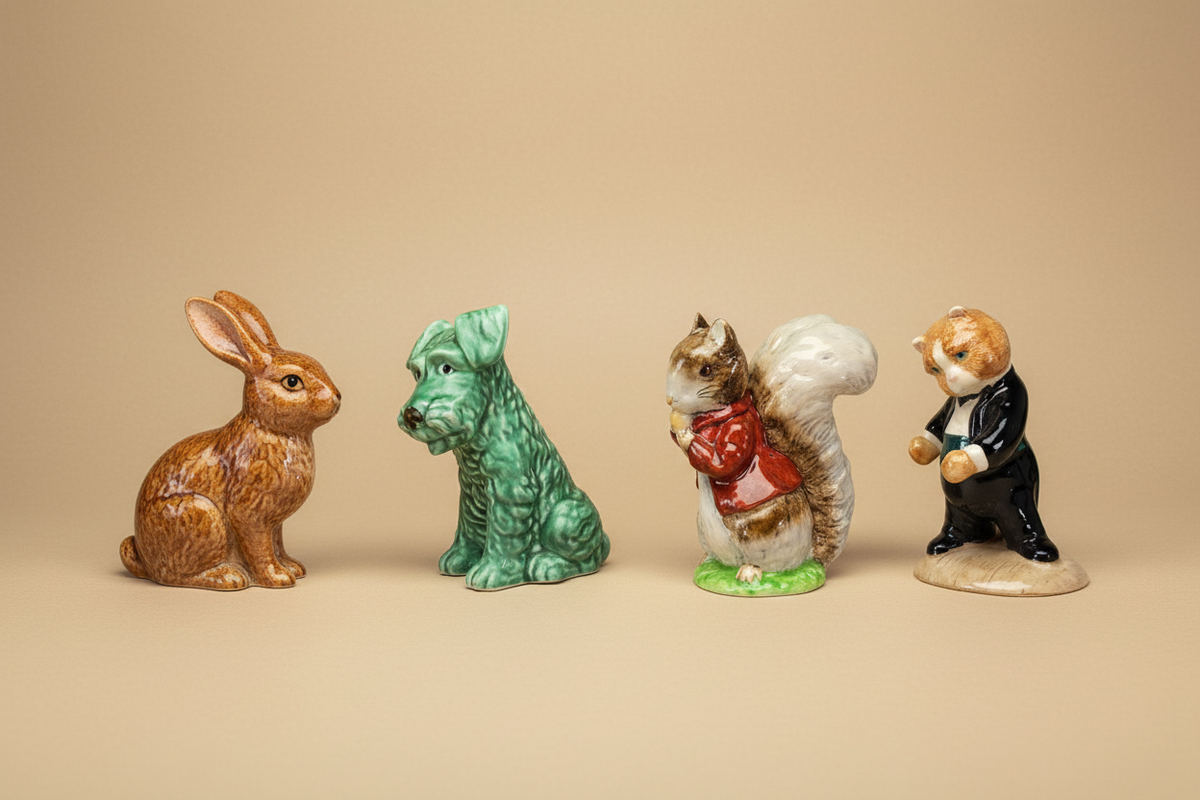

Pick up a SylvaC rabbit, a Beswick collie or a Wade Whimsy, and there's a good chance all three were made within a few miles of each other, by companies working through much the same history at much the same time. In this series we share their stories, one maker at a time, starting with the two questions we found ourselves asking first: why did so many of these potteries exist in the same place, and why did so many of them land on animals, novelty ware and cheerful decorative tableware at roughly the same moment?
Why Staffordshire Became "The Potteries"
Almost every maker in this series traces back to the same small part of England: North Staffordshire, an area that grew into six adjoining towns: Burslem, Fenton, Hanley, Longton, Stoke, and Tunstall. Previously simply known as “The Potteries”, these towns, taken together, formed the world’s leading centre for ceramics production, with many famous pottery houses like Spode, Wedgwood and Royal Doulton making this their home.
An abundance of natural resources, including easily accessible deposits of coarse red and brown terracotta clay, coalfields that provided a cheap, local fuel supply to fire the pottery kilns and nearby deposits of lead and salt needed to create early protective, waterproof ceramic glazes, made The Potteries the ideal location for the thousands of iconic "bottle ovens" that eventually dominated the skyline. The area’s natural advantage was compounded in 1777 when Josiah Wedgwood championed the Trent and Mersey Canal, giving local factories a practical way to bring in materials and ship out finished products at scale. By 1785, Staffordshire already had around 200 potteries employing some 20,000 people. This explains why, more than a century later, SylvaC, Beswick and so many others could all draw on the same pool of skilled modellers, decorators and kiln workers, and why a new pottery starting up nearby had every reason to specialise in something distinctive rather than compete head-on with its neighbours.

The War, Utility Ware and the Return of Colour
The other major turning point in this story is the Second World War. From June 1942, the Board of Trade's Utility Ware scheme restricted domestic pottery to plain white, ivory or natural stoneware, with no surface decoration permitted at all, even backstamps were limited to a maker's name, trademark and a price-group letter. Decorated ware did not disappear entirely; it continued to be produced for export throughout the war, since it earned valuable foreign currency, with the North American market a particular priority. But for the home market, colour and decoration were effectively switched off for a decade.
Restrictions eased gradually from 1945, but full decontrol on the manufacture, decoration, and sale of ceramics only came in August 1952. When it did, English potteries had the chance to reconnect with a home market that had gone more than ten years with almost nothing designed for it. The result was a variety of products with colour, character and charm, with a thriving market for cheerful, affordable novelty ware.
A Golden Age for Novelty and Decorative Ware
Many of the potteries were already creating ranges of novelty items prior to the war, for example, SylvaC's rabbits went into production in the 1930s, and Beswick had been refining its naturalistic animal modelling for decades before that. The 1952 decontrol opened the floodgates industry-wide, giving every maker in Staffordshire, established or not, a home market once again willing to buy colour, character and personality rather than plain, regulation whiteware. While not the birthplace of every collection, this era is what truly launched and defined a whole generation of English potteries.
Which Makers Are Covered in This Series?
This series covers Staffordshire potteries known for figurines, novelty ware and decorative tableware, one maker per guide. Each guide explains the maker's history, how to read their marks, which ranges collectors look for, and what to check before buying.
Read more about SylvaC, known for matt-glazed rabbits and terriers, and one of the earliest potteries to prove there was a real market for characterful animal ware.
Other guides coming soon include:
- Beswick - another great animal modeller and creator of beautiful bowls and jugs
- Wade Ceramics - pocket-sized Whimsies
- Crown Devon - Art Deco lustreware
- Royal Doulton - output beyond its famous figurines
- Denby - stoneware glazes
- Midwinter - mid-century pattern design
- Poole Pottery - the later Contemporary and Freeform years
- Shorter & Son - Art Deco novelty ware, fish vases and its Clarice Cliff connection
This page will be updated with a link to each guide as it gets published.
How to Use This Series
Think of these guides as one growing reference, not a set of one-off posts. Every maker in this series comes from the same corner of Staffordshire, the same handful of decades, and often the same starting ingredients: a matt or gloss glaze, a charming animal figure, a shape number pressed into the base. The more of these guides you read, the easier it gets to spot an unmarked piece, or to know exactly which maker's style belongs on your shelf.
New guides are added to this series regularly, so bookmark this page and check back often - you won't want to miss the next one!
Final Thought
These potteries were never trying to become collectible. They made honest, affordable, everyday pottery for a generation finally allowed to enjoy colour again after years of wartime restrictions. That simple, sometimes whimsical charm is exactly what still makes them so appealing today.
We'll add a new guide to this series every time one is ready, so bookmark this page and check back as it grows.
Ready to start exploring? Dive into the SylvaC guide next, then watch this space as we add Beswick, Wade, Crown Devon, Royal Doulton and more. Know a Staffordshire maker that belongs here? We'd love to hear from you. While you're here, have a browse through our current SylvaC Ceramics and Beswick collections, or learn more about us on the About Us page.
Sources
- Potteries.org, "Ten Plain Years: The British Pottery Industry 1942-1952", Utility Ware restrictions and 1952 decontrol: https://www.thepotteries.org/wartime/
- Homes & Antiques, "A history of the potteries", Staffordshire geology, the Trent and Mersey Canal and 18th century industry growth: https://www.homesandantiques.com/antiques/collecting-guides-antiques/design-icons/history-of-the-potteries
- Historic England (Heritage Calling), "A History of Stoke-on-Trent in 8 Places," 2 May 2025: https://heritagecalling.com/2025/05/02/a-history-of-stoke-on-trent-in-8-places/