
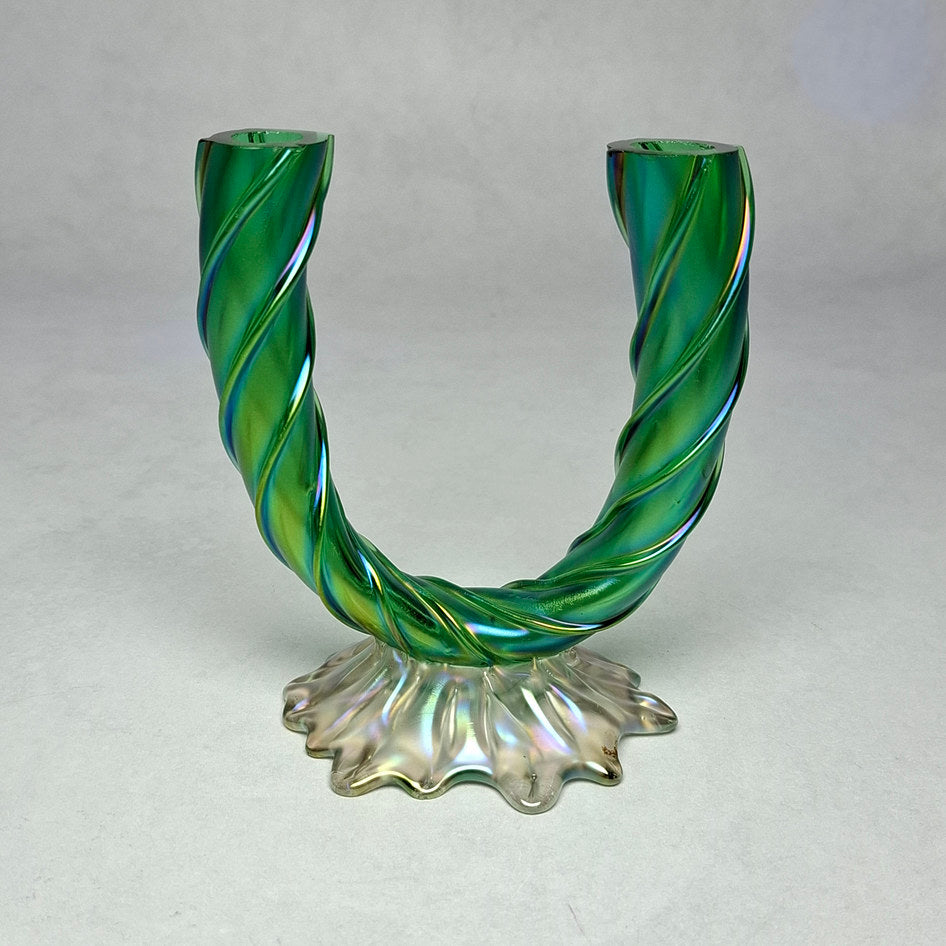
Some pieces of glass are immediately sculptural. The Antique Art Nouveau Iridescent Glass Twin U-Stem Vase in the Collectibles by Deon collection is one of them. With its twin U-stem form, luminous green iridescent finish, spiral trailing and flared opalescent base, the piece has the expressive movement and optical richness that made early 20th century art glass so distinctive. Browse the full art glass collection and the glass vases collection to see all pieces currently available.
A note on maker and origin
Based on the form, iridescent finish, spiral trailing and close comparison with documented Art Nouveau twin-stem glass forms, this vase is best described as attributed to Kralik, Bohemia, c. 1900-1910. Kralik, more fully known as Wilhelm Kralik Sohne, was a Bohemian glassworks associated with decorative art glass during the late 19th and early 20th centuries. Bohemian glass from this period is highly regarded by collectors for its colour, iridescence, moulded forms, applied decoration and inventive shapes. This vase should be described as attributed to Kralik rather than definitively Kralik because no original paper label, engraved signature or factory documentation is visible. That careful wording is important for accuracy and collector trust.
Why Kralik is the strongest attribution
The strongest attribution clue is the vase's form. Twin tube or twin stem Art Nouveau vases are closely associated with Bohemian glass production, and comparable twin tube iridescent examples are often attributed to or identified as Kralik. The green iridescent surface, applied spiral ribbing and sculptural form all sit comfortably within the Kralik and wider Bohemian Art Nouveau glass tradition. The piece also has a decorative confidence typical of early 20th century art glass. It does not rely on painted decoration. Instead, the design comes from the glass itself: colour, form, iridescence, applied trails and the flared base.
The Art Nouveau context
Art Nouveau flourished around the turn of the 20th century. It favoured flowing lines, natural inspiration, movement and craftsmanship. Glass was one of the perfect materials for this style. When hot, it could be stretched, twisted, trailed, blown, moulded and shaped into fluid forms. When finished with an iridescent surface, it could imitate the shimmer of shells, beetle wings, oil on water or ancient weathered glass. This vase reflects that Art Nouveau love of movement. The two green stems curve upward in a U shape, while the spiral trailing gives the impression of growth, twist and organic energy.
What makes the form unusual
The twin U-stem shape is one of the most interesting features of the piece. Instead of one central vase opening, the design uses two upright stems joined by a curved lower section. This creates a more sculptural silhouette that can be read as a double bud vase, a decorative centrepiece, or simply as an art glass object. The form is practical enough to hold small stems, but its main appeal is visual. It was clearly made to be displayed and admired. The shared flared base gives the piece balance, and the opalescent glass at the base softens the design and contrasts beautifully with the vivid green upper section.
The iridescent finish
The green iridescent surface is central to the appeal of this vase. Depending on the light, the colour shifts between emerald, blue, gold and bronze. This changing surface gives the piece depth and movement, even when it is standing still. Iridescent glass was one of the defining decorative achievements of the Art Nouveau period. Makers in Europe and America experimented with metallic surface effects to create glass that shimmered and changed as it caught the light. On this vase, the iridescence works especially well because of the spiral trailing. The raised trails catch light differently from the smooth areas, creating highlights and shadows across the surface.
Spiral trailing and texture
The spiral trailing running along each stem adds both texture and rhythm. Applied trailing is created when molten glass is added to the body of the piece in a line, thread or raised pattern. On this vase, the trailing follows the curve of each stem, emphasising the upward movement. This detail gives the piece a stronger handworked character and helps separate it from plainer green glass vases, because the decoration is built into the form rather than added as surface painting.
The opalescent base
The flared base is another important design feature. Its soft opalescent tone gives the vase a lighter, almost shell-like quality. It anchors the two green stems while adding a different type of luminosity. The base also has a naturalistic feeling. Its flared, petal-like edge complements the Art Nouveau preference for organic forms and flowing outlines. Together, the green iridescent stems and opalescent base create a strong contrast between colour and softness, movement and stability.
Is this vase rare?
It is better not to describe this vase as rare unless a confirmed catalogue match, maker record or production information can be found. However, it can fairly be described as an unusual and less commonly encountered sculptural form. The twin U-stem shape, spiral trailing, iridescent green finish and opalescent base make it more distinctive than many standard single-stem or simple bud vases from the period. For collectors, the appeal lies in its form, period character, probable Bohemian origin and strong Art Nouveau presence.
What collectors should look for
When assessing Art Nouveau iridescent glass, condition is very important. Collectors should check for chips to the rims, cracks in the stems, bruising to the base, loss or wear to the iridescent finish, damage to applied trailing, grinding or polishing that may indicate repairs, and heavy scratches or clouding. The openings on twin-stem vases are especially important because they are exposed and vulnerable. The base should also be checked carefully because it carries the weight of the piece.
How to style this vase
This vase deserves to be displayed where light can reach it. A glass cabinet, windowside shelf, mantel or sideboard would allow the iridescent surface to shift naturally throughout the day. It can stand alone as a sculptural focal point, or it can be grouped with other Art Nouveau, Bohemian or iridescent glass pieces. It would pair beautifully with Loetz-style iridescent glass, Kralik and Bohemian glass, opalescent glass, green art glass, Art Nouveau ceramics, metallic decorative objects and natural forms such as botanical prints or floral ceramics. Because the vase already has strong movement, it does not need a crowded display. A little space around it will allow the silhouette to be appreciated.
Why this piece is special
This attributed Kralik Art Nouveau iridescent twin-stem vase is special because it combines several qualities collectors look for in early 20th century decorative glass: a distinctive sculptural form, a luminous iridescent finish, applied spiral trailing, an opalescent flared base and strong Art Nouveau character. It is also a piece that invites careful study. The more closely it is viewed, the more the surface, colour and form reveal themselves. For collectors of Bohemian art glass, Art Nouveau design, iridescent glass or unusual sculptural vases, this is a highly distinctive display piece with strong historical and decorative appeal.
If you enjoy art glass and collector guides, you may also find our articles on Art Glass Collecting in South Africa: How to Identify Quality Glass and Avoid Cheap Imitations and Attributed Baccarat Frosted Crystal Dog Paperweights: French Pressed Glass Collectables of interest.
View the Antique Art Nouveau Iridescent Glass Twin U-Stem Vase in the collection, or explore all pieces in the art glass collection at Collectibles by Deon. For enquiries, visit the Contact page or learn more on the About page.