
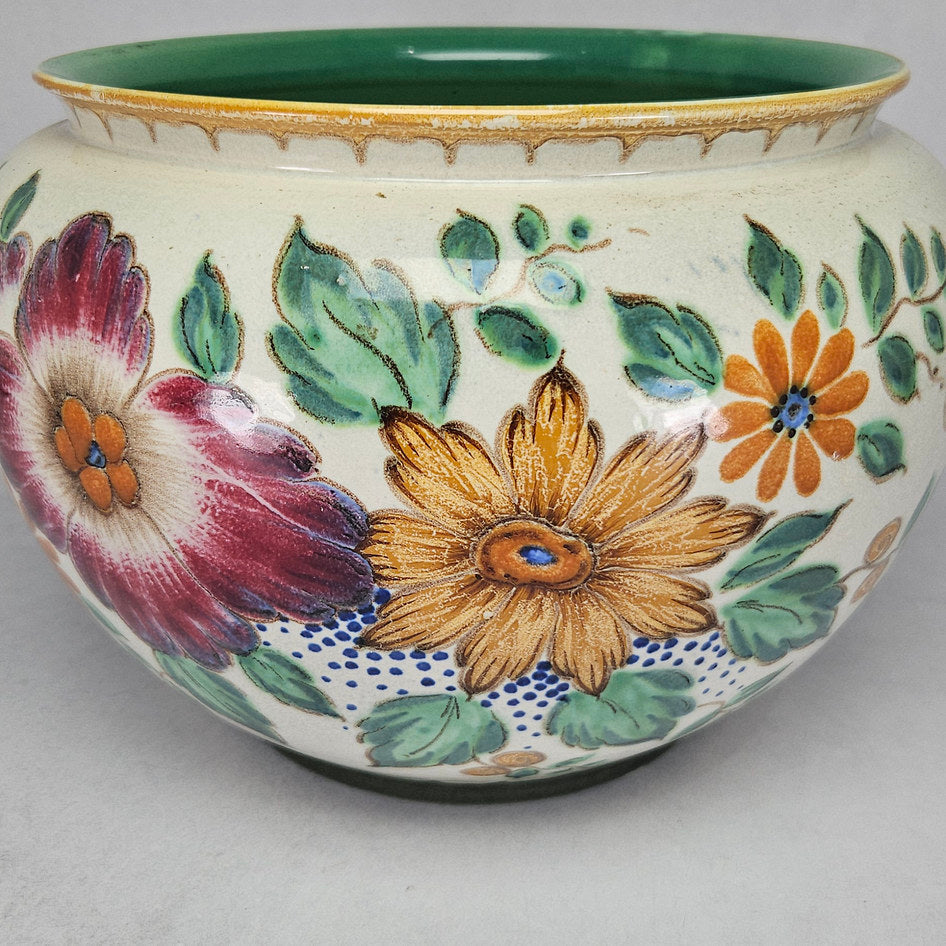
PZH Gouda Toos hand-painted polychrome floral ceramic cachepot with green interior, cream crackle-glazed ground and bold flower decoration, Dutch Gouda pottery

Gouda pottery is one of the most visually striking categories in the world of decorative ceramics, and it is increasingly sought after by South African collectors. Produced in and around the city of Gouda in the Netherlands from the late nineteenth century, Gouda plateel ware is characterised by its rich, jewel-like colours, flowing Art Nouveau and Art Deco designs, and bold hand-painted decoration. Whether you are drawn to the cobalt-blue and orange of a PZH Plazuid cachepot or the soft florals of a Flora Gouda vase, the range is broad enough to suit collectors at every level of experience and budget.

This guide covers the history of the Gouda pottery tradition, the main factories you will encounter, how to identify and date pieces using marks, and what to look for when assessing pieces in the Collectibles by Deon Gouda pottery collection.

A Brief History of Gouda Pottery

The city of Gouda in the South Holland province of the Netherlands has a long history of clay-based industry, but the decorative pottery tradition that collectors now associate with the Gouda name emerged in the late nineteenth century. The plateel tradition, the production of hand-painted earthenware with coloured slip decoration, developed rapidly in Gouda from around 1898, driven by the influence of the Arts and Crafts movement and the broader European interest in decorative art pottery.

The early Gouda style was strongly influenced by Art Nouveau, with flowing organic forms, stylised plant and flower motifs, and a characteristic matte glaze that gave the surface a soft, velvety quality. By the 1920s, the style had shifted towards the bolder, more geometric forms of Art Deco, and the colour palette became richer and more saturated. Both periods produced distinctive and collectible wares, and pieces from both the Art Nouveau and Art Deco phases are actively collected today.

Production continued through the mid-twentieth century, with some factories adapting to more commercial styles and brighter, glossier glazes. The most collectible Gouda pieces are generally those from the earlier plateel tradition, with strong hand-painted decoration, clear factory marks, and named decors.

The Main Gouda Pottery Factories

Plateelbakkerij Zuid-Holland (PZH)

Plateelbakkerij Zuid-Holland, known by the initials PZH, was one of the most significant Gouda pottery producers. The factory operated in Gouda from 1898 and is recognised by its distinctive Lazarus Gate device, which appears on the base of pieces alongside the Gouda and Holland wording. From 1928, the factory also used the Plazuid mark, a contraction of Plateelbakkerij Zuid-Holland, and pieces from this period carry the Plazuid, Gouda, and Holland wording alongside the gate device.

PZH produced a wide range of decorative forms including vases, cachepots, plates, and dishes, decorated with named decors. The Aurora decor, with its bold cobalt-blue ground and warm orange, yellow, and turquoise floral motifs, is among the most recognisable PZH patterns. The PZH Plazuid Gouda Aurora Polychrome Floral Ceramic Cachepot and the PZH Plazuid Gouda Aurora 198 Polychrome Floral Ceramic Cachepot in the collection are strong examples of this decor. The PZH Gouda Polo Hand-Painted Floral Ceramic Plate, the Royal Zuid-Holland PZH Gouda Grace Pierced Floral Ceramic Plate, the Royal Zuid-Holland PZH Gouda Amici Floral Ceramic Vase, the Royal Zuid-Holland PZH Gouda Floral Ceramic Basket Dish, and the PZH Gouda Toos Hand-Painted Floral Ceramic Cachepot are further examples of the factory's output across different forms and decors.

Plateelbakkerij Flora

Plateelbakkerij Flora was another significant Gouda pottery producer, operating through the mid to late twentieth century. Flora pieces are marked with the Flora Gouda Holland wording, often accompanied by a decor name and a model or shape number. The factory's output is characterised by bright, cheerful floral decoration in a range of colourways, with a style that sits comfortably in the post-war decorative tradition.

The Flora Gouda Holland Aster Hand-Painted Floral Ceramic Jug, marked with the Aster decor name, and the Flora Gouda Holland Simone Hand-Painted Floral Ceramic Vase, marked with the Simone decor name, are good examples of Flora's floral output in the collection.

Zenith Gouda

Zenith Gouda, also known as Fa. P.J. v/d Want AZ, was a Dutch Gouda pottery producer whose wares are recognised by collectors for their strong glaze textures and mid-century character. Zenith pieces are marked with the Zenith Gouda wording and sometimes retain a paper body label. The factory's output includes a range of decorative forms with textured and speckled glazes that give the pieces a distinctive tactile quality. The Zenith Gouda Brown Glazed Ceramic Jug in the collection is a good example of the factory's characteristic glaze work.

Regina Gouda

Regina of Gouda was a respected Dutch pottery producer known for elegant gilt detailing and warm cream glazes. Regina pieces are marked with the Regina name and a crown device, often accompanied by a Hand Painted Made in Holland wording and a shape or model number. The factory's output has a more refined, decorative character than some of the bolder plateel producers, with an emphasis on gilt trim and restrained floral decoration. The Regina Gouda Holland Hand-Painted Cream and Gold Ceramic Jug in the collection is a good example of the factory's characteristic style.

Other Gouda and Holland Pottery Producers

Beyond the named factories above, a significant number of Gouda and Holland pottery pieces carry marks that support a Dutch origin but do not confirm a specific factory. Pieces marked Gouda and Holland, or carrying marks such as Genuine Gouda Holland, Gouda Ware, or Cora Holland, are catalogued as Dutch Gouda-style pottery rather than attributed to a specific factory. The Gouda Holland MIA Hand-Painted Floral Ceramic Jug, the Hand-Painted Gouda Ware Made in Holland Floral Ceramic Jug, and the Genuine Gouda Holland Hand-Painted Black Floral Ceramic Jug are examples of this broader category.

Unmarked pieces with the decorative character of Gouda-style pottery are catalogued as Gouda-style art pottery rather than attributed to a specific factory. The Unmarked Gouda-Style Polychrome Floral Ceramic Vase and the Unmarked Gouda-Style Polychrome Floral Ceramic Bud Vase in the collection are examples of this approach.

Gouda Pottery Marks and How to Read Them

Gouda pottery marks are generally handwritten or impressed on the base of pieces, and reading them carefully is the first step in identifying and dating a piece. Key elements to look for:

  • Factory name or device: the factory name (PZH, Flora, Zenith, Regina) or a factory device such as the PZH Lazarus Gate identifies the maker. The Plazuid wording on PZH pieces indicates production from 1928 onwards.
  • Gouda and Holland: the wording Gouda and Holland on the base confirms Dutch origin and is required for export pieces produced after 1891. Pieces marked Holland only, without Gouda, may be from a different Dutch pottery region.
  • Decor name: many Gouda pieces carry a handwritten decor or pattern name on the base, such as Aurora, Aster, Simone, or Polo. The decor name identifies the specific painted design and is useful for matching pieces within a set or series.
  • Model or shape number: a number on the base typically refers to the shape or model of the piece rather than a production date. Numbers should not be interpreted as year dates unless supported by other evidence.
  • Painter or decorator marks: single letters or initials on the base are generally treated as painter or decorator marks rather than date codes, unless the factory's marking system is specifically documented.
  • Hand Painted or Handpainted: the explicit statement of hand-painted decoration on the base confirms that the decoration was applied by hand rather than by transfer printing.

Read our guide to dating antique ceramics for broader context on reading pottery marks and backstamps.

What to Look For When Collecting Gouda Pottery

  • Decoration quality: the quality of the hand-painted decoration is the most important factor in assessing a Gouda piece. Look for crisp, confident brushwork, well-defined outlines, and even colour application. Smudged, hesitant, or poorly applied decoration indicates lower-quality production.
  • Glaze condition: crazing, the fine network of cracks in the glaze surface, is common on older Gouda pieces and is generally accepted by collectors as part of the character of the piece. Chips, glaze losses, and repairs are more significant condition issues and should be noted carefully.
  • Mark legibility: a clear, legible base mark with a factory name, decor name, and Holland wording supports attribution and adds to the collectibility of a piece. Pieces with unclear or worn marks are catalogued more cautiously.
  • Form integrity: examine rims, handles, spouts, and lids carefully for chips and hairlines. The rim and handle are the most vulnerable points on jugs and vases. Pierced borders on plates are particularly vulnerable to chipping.
  • Gilt trim condition: on pieces with gold-coloured trim, examine the gilding carefully for rubbing and wear. Significant gilt loss reduces the decorative impact of the piece.
  • Named decors: pieces with a clearly identified decor name on the base are generally more collectible than unmarked or partially marked examples, as the decor name allows the piece to be placed within the factory's documented output.

Gouda Pottery in South Africa

Gouda pottery arrived in South Africa through the colonial trade networks of the early and mid-twentieth century, and pieces appear regularly at South African estate sales, auction houses, and antique markets. The bold colours and strong decorative character of Gouda plateel ware make it well suited to the South African interior aesthetic, and the category is growing in popularity among local collectors.

The Kelly's for Gifts retailer label, associated with the Port Elizabeth retailer, appears on some Gouda pieces in South African collections, confirming that pieces were sold through established South African retail channels. The Royal Zuid-Holland PZH Gouda Grace Pierced Floral Ceramic Plate in the collection retains such a label.

Browse the full Gouda pottery collection at Collectibles by Deon, or explore related pieces in the Ceramics collection. For questions about specific pieces or patterns, visit our contact page or learn more about the store.

Frequently Asked Questions

What is Gouda pottery?

Gouda pottery refers to the decorative earthenware produced in and around the city of Gouda in the Netherlands from the late nineteenth century. It is characterised by hand-painted decoration in rich colours, flowing Art Nouveau and Art Deco designs, and a matte or semi-gloss glaze. The tradition is also known as Dutch plateel ware. The main collecting categories are pieces from the named factories including PZH, Flora, Zenith, and Regina, as well as pieces marked Gouda Holland without a specific factory attribution.

How do I identify genuine Gouda pottery?

Genuine Gouda pottery carries a base mark that typically includes the factory name or device, the Gouda wording, and the Holland wording. The decoration is hand-painted rather than transfer-printed, and the base mark is generally handwritten rather than printed. Pieces without a clear Gouda and Holland mark are catalogued as Gouda-style rather than confirmed Gouda pottery. Read our guide to dating antique ceramics for more detail on reading marks.

What is the difference between PZH and Plazuid?

PZH and Plazuid both refer to Plateelbakkerij Zuid-Holland of Gouda, Holland. PZH is the abbreviation of the factory name, while Plazuid is a contraction used on pieces produced from 1928 onwards. Both marks are accompanied by the PZH-style Lazarus Gate device on the base. Pieces marked Plazuid are therefore post-1928 production from the same factory.

Is crazing on Gouda pottery a problem?

Crazing, the fine network of cracks in the glaze surface, is common on older Gouda pottery and is generally accepted by collectors as part of the character of the piece rather than a significant condition issue. More significant concerns are chips, glaze losses, and repairs, which should be noted carefully and reflected in the price. Read our guide to cleaning antique ceramics for advice on caring for crazed pieces.

How do I clean Gouda pottery?

Gouda pottery should be cleaned gently with a soft, damp cloth. Avoid abrasive cleaners, soaking, or dishwasher use. Pieces with matte glazes are particularly vulnerable to staining and should be handled with clean hands. Crazing can trap dirt and oils, so gentle surface cleaning is preferable to any attempt at deep cleaning. Read our guide to cleaning antique ceramics for full advice.

What is the most collectible Gouda pottery?

The most collectible Gouda pieces are generally those from the earlier plateel tradition, with strong hand-painted decoration in the Art Nouveau or Art Deco style, clear factory marks, named decors, and good condition. PZH pieces with bold Aurora or similar decors, and pieces from the pre-war period with matte glazes and flowing organic designs, are among the most sought-after. Named decors and clear factory attribution add to collectibility across all factories.

A rewarding category for collectors of Dutch Gouda pottery, decorative ceramics, or South African and international art pottery. Browse the Gouda pottery collection to explore available pieces, or contact us to ask about specific factories or decors. You can also learn more about the store.