
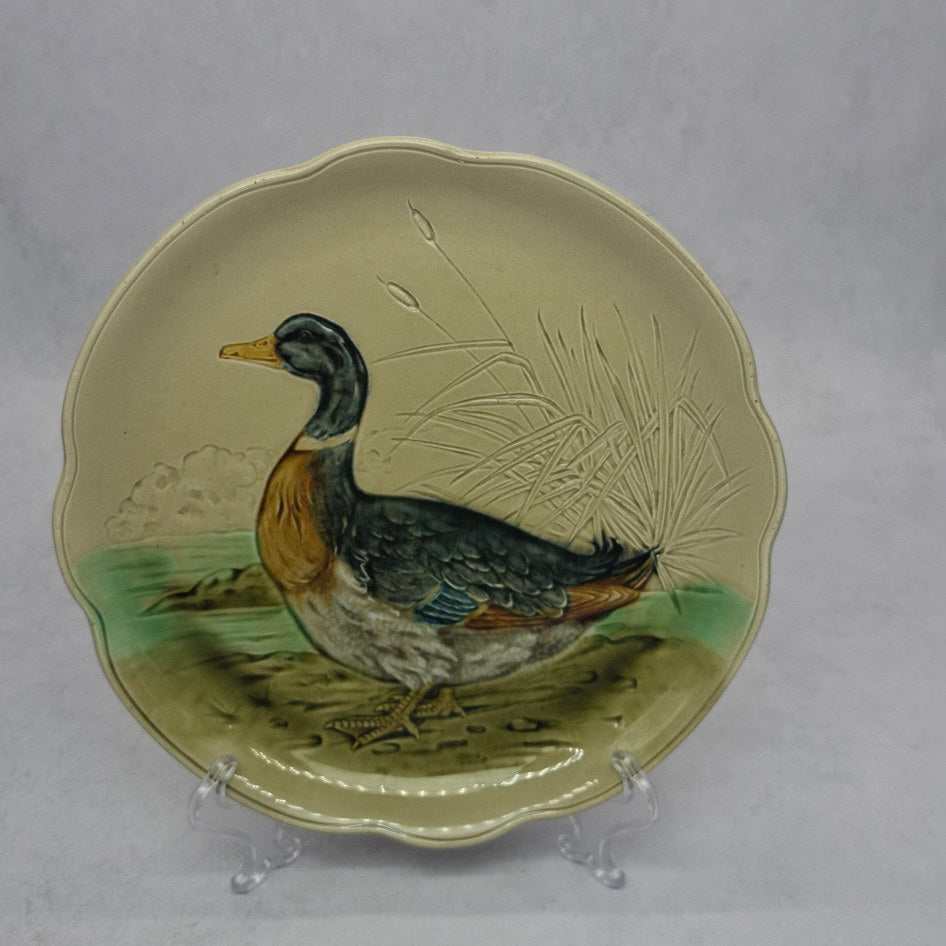
Majolica is one of the most colourful and characterful categories in ceramic collecting. The term covers a broad tradition of tin-glazed and lead-glazed earthenware produced across Europe from the Renaissance period onward, as well as the distinctive Victorian majolica produced in Britain and America from the 1850s. For collectors, majolica offers bold colour, strong sculptural form, and a wide range of makers, periods, and price points.
The Origins of Majolica
The word majolica derives from Majorca, the Spanish island through which tin-glazed earthenware from the Islamic world was traded into Renaissance Italy. Italian potters in Faenza, Deruta, Urbino, and other centres developed the tin-glazed earthenware tradition into a sophisticated art form, producing pieces decorated with narrative scenes, heraldic motifs, and elaborate ornamental designs. This Italian tradition, known as maiolica in its original form, spread across Europe and influenced the development of Delftware in the Netherlands, faience in France, and similar traditions in Spain, Portugal, and Germany.
Victorian Majolica
The Victorian majolica that most collectors encounter today is a distinct tradition from the Italian Renaissance original. It was developed in Britain in the 1850s, with Minton credited as the primary innovator. Victorian majolica uses lead glazes in strong, opaque colours, typically applied over a moulded earthenware body. The characteristic colours are turquoise, green, yellow, brown, and pink, applied in bold, naturalistic schemes. The forms are often sculptural and naturalistic: leaf plates, shell dishes, animal figures, garden seats, and elaborate centrepieces.
The major Victorian majolica makers include Minton, George Jones, Wedgwood, Royal Worcester, and a range of smaller Staffordshire potteries. American majolica, produced by Griffen, Smith and Hill and others, followed the British tradition closely. Continental European factories, particularly in Austria and Germany, also produced majolica in the Victorian period.
Schütz Cilli Majolica
Schütz Cilli was an Austrian pottery based in Celje (then Cilli), in present-day Slovenia, which produced majolica and earthenware from the late nineteenth century. Schütz Cilli pieces are characterised by their naturalistic moulded decoration and their use of the rich, opaque majolica glazes associated with the broader Central European tradition. The Schütz Cilli Majolica Wall Plate Model 887 with Landscape Decoration is a documented example of the factory's output, with the model number and factory mark providing reliable identification. Schütz Cilli pieces are less commonly encountered in South Africa than British majolica and represent a genuine point of difference for the collector who enjoys the broader European tradition.
Majolica Beyond Tableware
The majolica glaze tradition extended well beyond tableware and decorative ceramics. Majolica glazing was applied to functional objects including garden ornaments, umbrella stands, jardinières, and lamp bases. The Antique Brass Kerosene Oil Lamp with Green Majolica Ceramic Cover is a striking example of how the majolica aesthetic appeared on functional objects, with the rich green glaze providing the characteristic colour and surface quality of the tradition in a practical form. Pieces like this appeal to collectors who enjoy the intersection of decorative and functional antiques.
Identifying Majolica
Identifying majolica requires attention to the glaze, the body, and the mark. Victorian majolica uses lead glazes that produce a characteristic depth and richness of colour. The earthenware body is typically buff or grey, visible at unglazed areas such as the foot rim. Marks on Victorian majolica vary considerably: Minton pieces are typically well marked, while many smaller factory pieces are unmarked or carry only a pattern number. Continental European pieces often carry factory marks that can be cross-referenced against ceramic reference works.
When assessing a piece, look for the quality and richness of the glaze colours, the sharpness of the moulded decoration, and the condition of the surface. Majolica glaze can craze, chip, and flake, and condition is a significant factor in collector value. Pieces with strong, undamaged glaze and crisp moulding are the most desirable.
Is Majolica Rare?
Majolica should not automatically be described as rare. Many Victorian majolica pieces were produced in large numbers, and some forms are still regularly found on the secondary market. However, certain pieces can be less commonly encountered. Examples that may have stronger collector interest include unusual forms, well-known makers, large display pieces, animal figures, complete sets, strong colourways, sharply moulded examples, and pieces in excellent condition. The safest wording is usually collectable, desirable, unusual, or less commonly encountered, with rare reserved only for pieces where there is clear supporting evidence.
How to Use Majolica in a Display
Majolica is wonderful for display because it brings colour, texture, and personality to a room. A leaf plate can be displayed on a stand or wall, as seen with the Schütz Cilli Majolica Wall Plate. A colourful jug can sit beautifully on a shelf or sideboard, and a majolica bowl or dish can add warmth to a cabinet grouping. For something more unusual, the Antique Brass Kerosene Oil Lamp with Green Majolica Ceramic Cover shows how majolica glazing appeared on functional objects beyond tableware. Majolica pairs especially well with botanical prints, green glass, brown transferware, art pottery, Victorian ceramics, rustic wood, brass and metalware, and floral china. Because majolica is usually bold, one strong piece can become a focal point, while a group of related pieces creates a highly decorative collector's display.
What to Look For When Buying Majolica
When buying majolica, look for good colour, clear moulding, and honest condition. Sharp moulded detail is a good sign. Leaves should show veining, animals should show texture, and decorative borders should feel crisp rather than blurred. Colour should feel rich and lively. Some variation is normal, especially on older pieces, but dull, heavily worn, or badly repaired surfaces should be noted. Marks are useful, but not every good majolica piece is marked. A beautiful unmarked piece can still be collectable if the form, glaze, condition, and age are appealing.
A Note on Use and Display
Many antique majolica pieces were made with lead glazes. Because of this, older majolica should generally be treated as decorative unless it is known to be food safe. Collectors should avoid using antique majolica for serving food unless the piece has been professionally assessed as safe for that purpose. It is best enjoyed as decorative pottery, where the glaze, form, and colour can be fully appreciated.
For a later Italian example of the maiolica tradition, see the Cantagalli hand-painted cup and saucer. Its cockerel marks identify a different tradition from Victorian lead-glazed majolica, and the cup and saucer are listed as a separate pair.
Why Majolica Remains Collectable
Majolica remains collectable because it is joyful, decorative, and full of character. It reflects important ceramic histories, from Islamic tin-glazing traditions and Renaissance Italian maiolica to the colourful Victorian ceramics produced in Britain and America. For collectors, majolica offers variety. Some pieces are refined and historical. Others are playful, naturalistic, and full of Victorian charm. This makes majolica a flexible and rewarding collecting area.
Explore the Ceramics collection and Ornaments at Collectibles by Deon, and discover unique pieces selected for collectors, decorators, and lovers of colourful ceramic history. See what has just arrived in the latest additions, or contact us with any enquiries. Learn more about the store and how each piece is sourced.