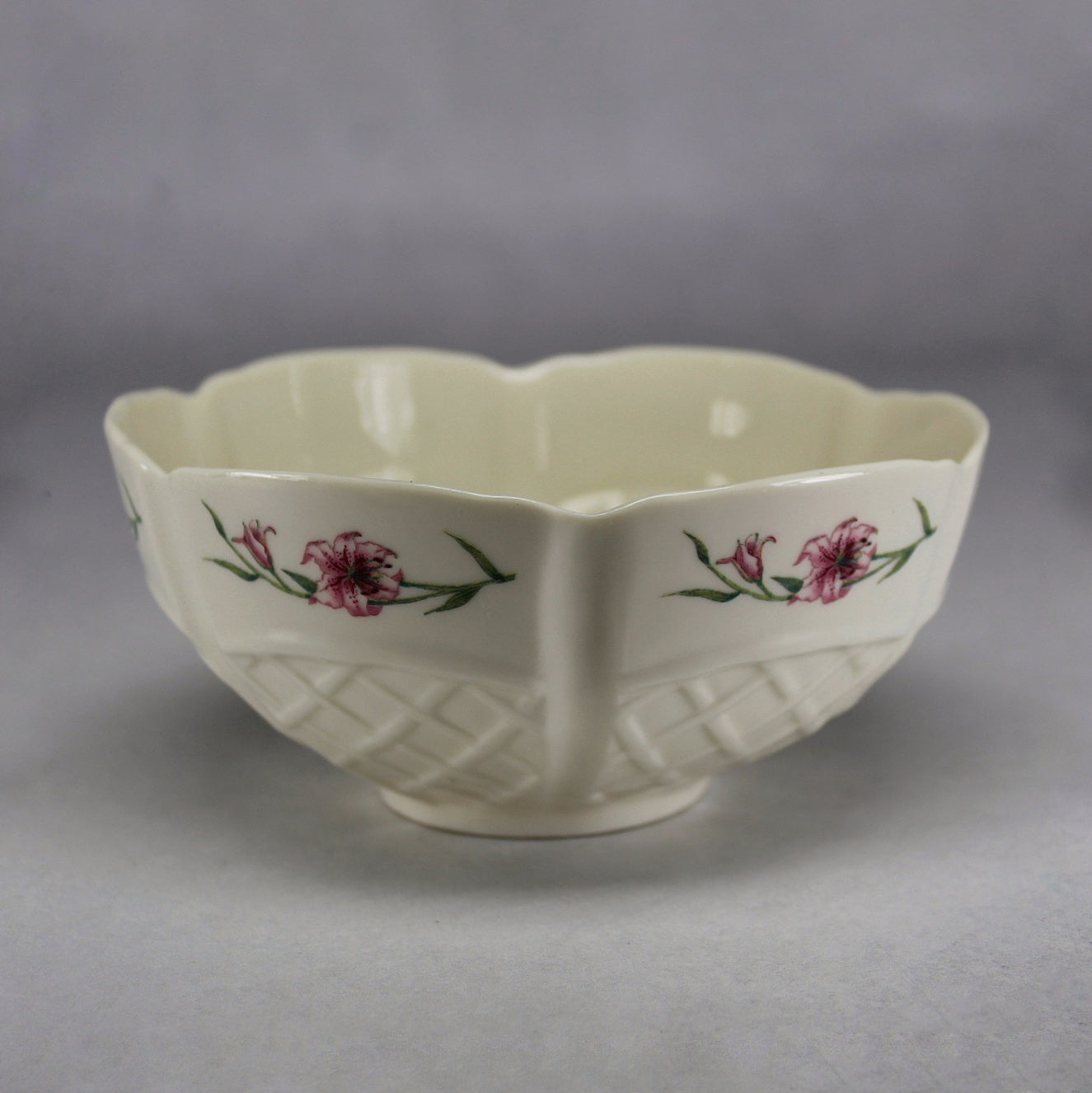
Belleek is one of the most distinctive names in Irish ceramics, and one of the most immediately recognisable in the broader world of fine porcelain collecting. Produced in the village of Belleek in County Fermanagh, Northern Ireland, since 1857, Belleek is known for its creamy parian ware body, its lustrous glaze, and its intricate basket weave and naturalistic decoration. For collectors, Belleek offers a combination of Irish heritage, documented maker history, and a mark system that allows pieces to be dated with considerable precision.
A Brief History of Belleek Pottery
The Belleek Pottery was established in 1857 by John Caldwell Bloomfield, Robert Williams Armstrong, and David McBirney, on the banks of the River Erne in County Fermanagh. The factory developed its distinctive parian ware body, a fine, translucent porcelain with a creamy white colour and a characteristic lustrous glaze, in the early years of production. The basket weave technique, in which individual strands of clay are woven together to create intricate lattice forms, became one of Belleek's most celebrated and technically demanding specialities. The factory has operated continuously since 1857, with a brief closure during the Second World War, and remains in production today.
The Belleek Mark System
The Belleek mark system is one of the most useful in ceramic collecting, allowing pieces to be dated to a specific production period with reasonable confidence. The marks are numbered from the First Mark (1863 to 1890) through to the current Eleventh Mark, and the colour of the mark, black, green, or gold, provides an immediate broad dating indicator. Black marks indicate production before 1946. Green marks indicate production between 1946 and approximately 1980. Gold marks indicate production from 1980 onward. The specific mark number can be cross-referenced against published Belleek collector references for more precise dating.
First Mark pieces (black, 1863 to 1890) are the most sought after by serious collectors and command the highest prices. Second Mark pieces (black, 1891 to 1926) are also highly regarded. Earlier black-mark pieces generally command premiums over later green and gold mark examples of the same pattern and form.
Belleek Patterns and Forms
Belleek produced a wide range of forms and patterns across its history. The basket weave pieces, including vases, baskets, and centrepieces, are among the most technically demanding and most celebrated. The Shamrock pattern, featuring applied shamrock decoration on a basket weave ground, is the most widely recognised Belleek design and the most commonly encountered in the South African market. Other notable patterns include Tridacna, Neptune, Echinus, and the various floral and naturalistic designs produced across different mark periods.
The Ceramics collection at Collectibles by Deon includes Belleek pieces spanning several mark periods. The Belleek Shamrock Basket Weave Creamer with Second Mark is a classic example of the Shamrock pattern in one of its most practical forms, with the black Second Mark confirming pre-1926 production. The Belleek Shamrock Basket Weave Sugar Bowl with Green Mark is a mid-century example of the same pattern, with the green mark indicating post-1946 production. The Belleek Neptune Teacup and Saucer with Black Mark represents the Neptune pattern, one of Belleek's most elegant designs, in an early black-mark example.
What to Look For When Collecting
The mark is the starting point for any Belleek piece. Identify the mark number and colour, then assess the form, pattern, and condition. Belleek's parian ware body is delicate, and the basket weave pieces in particular are vulnerable to damage at the woven strands and applied decoration. Examine pieces carefully for chips, cracks, repairs, and missing elements. The lustrous glaze should be even and undamaged. On basket weave pieces, check that all strands are intact and that applied flowers or shamrocks are complete.
Belleek in South Africa
Belleek reached South Africa primarily through British colonial household imports and as gifts brought by Irish immigrants and visitors. It appears regularly at South African estate sales and auction houses, though complete sets are rare. Individual pieces, particularly basket weave vases and creamers, are the most commonly encountered forms in the local market.
Browse the Ceramics collection at Collectibles by Deon for currently available Belleek pieces, or explore the latest additions to see what has recently come in. For questions about specific marks or patterns, visit our contact page or learn more about the store.
Frequently Asked Questions
How do I date a piece of Belleek?
Check the base mark. The colour of the mark (black, green, or gold) and its specific design correspond to a documented production period. Black marks indicate production before 1946. Green marks indicate production between 1946 and approximately 1980. Gold marks indicate production from 1980 onward. The specific mark number can be cross-referenced against published Belleek collector references for more precise dating.
What is Belleek parian ware?
Parian ware is a type of unglazed or lightly glazed porcelain developed in Britain in the 1840s, named for its resemblance to Parian marble. Belleek's version is characterised by its creamy white colour, translucency in thin sections, and the distinctive lustrous glaze applied to many pieces. It is a fine, delicate body that requires careful handling.
Is Belleek still being made?
Yes. The Belleek Pottery has operated continuously since 1857 (with a brief wartime closure) and remains in production in Belleek, County Fermanagh, Northern Ireland. Current production pieces carry the Eleventh Mark in gold.
What is the most valuable Belleek mark?
Pieces carrying the First Mark (black, 1863 to 1890) are the most sought after by collectors and command the highest prices. Second Mark (black, 1891 to 1926) pieces are also highly regarded. Earlier black-mark pieces generally command premiums over later green and gold mark examples of the same pattern and form.
How do I clean Belleek?
Belleek should be dusted with a soft, dry brush. If washing is necessary, use lukewarm water and a very small amount of mild washing-up liquid, wash gently without scrubbing, rinse thoroughly, and dry immediately. Never put Belleek in a dishwasher. Read our guide to cleaning antique ceramics for full advice.
A rewarding category for collectors of Irish porcelain, fine bone china, or decorative ceramics with a documented maker history. Browse the Ceramics collection to explore available pieces, or contact us to ask about specific marks or patterns. Learn more about the store and how each piece is sourced.