
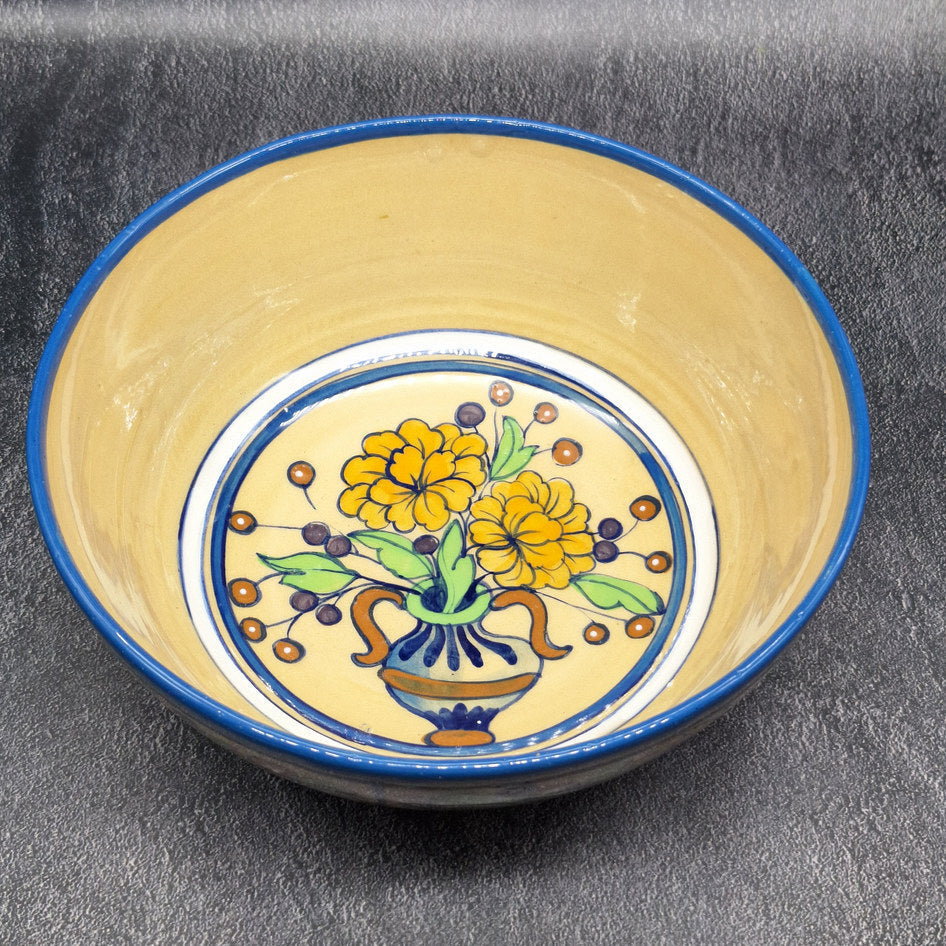
A rewarding category for collectors of South African decorative arts, mid-century ceramics, or ceramic vases with a local story.
Current examples in the collection include the Lucia Ware Black Ceramic Mantel Vase Style 5803, the Lucia Ware Hand-Painted Sailing Boat Ceramic Vase, and the Lucia Ware White Ceramic Scottish Terrier Dog Figurine.
Browse the South African Ceramics collection to explore available pieces, contact us to ask about specific makers, or learn more about the store and how each piece is sourced.
Major South African Pottery Makers
Lucia Ware is one of the most recognisable names in South African decorative ceramics. Its pieces are often appreciated for expressive hand painting, practical domestic forms, and the sense of local character carried by the decoration. Collectors should record the Lucia Ware mark, model or style number where present, dimensions, glaze, and any visible decorator detail.
Drostdy Pottery became closely associated with the South African studio pottery tradition and is collected for its distinctive forms, glazes, and regional identity. Crescent Potteries, Kalahari Pottery, Hamburger Pottery, and Benoni East Potteries represent other strands of local production, each with its own marks and preferred forms. Some pieces were made for everyday use, while others were designed primarily for display.
Studio Potters and Individual Practice
South African studio pottery also includes individual makers whose work may be encountered less frequently than factory wares. Jan du Toit, Dykor, and Clementina van der Walt are examples of names that reward further research. Their pieces are best understood through a combination of signature, form, glaze, decoration, documented exhibition history, and comparison with known examples.
How to Assess a Piece
Begin with the base and photograph every mark before cleaning or moving the piece. Note whether the mark is impressed, painted, printed, or signed, then compare it with reliable references. Shape and glaze are equally important because marks can be faint or incomplete. A confident attribution should be supported by several matching features rather than a single similarity.
Condition should be assessed honestly. Hairline cracks, chips, glaze loss, staining, and old repairs all affect a piece differently, while minor crazing may be part of the normal character of vintage earthenware. Clear measurements and photographs of the rim, handles, foot, and base make later comparison much easier.
Collecting Local Ceramics
Collecting South African pottery offers a direct way to study local design history. A focused collection might follow one maker, one region, a particular glaze, or the development of studio pottery through the twentieth century. It can also sit naturally alongside English and European ceramics, creating a display that shows both local production and the international influences that shaped it.
Browse the South African Ceramics collection at Collectibles by Deon, explore the wider Ceramics collection, or check New Arrivals for recently sourced pieces. For questions about a mark or maker, visit the contact page or learn more about the store.
Lucia Ware and Local Identity
Lucia Ware is particularly useful for understanding how South African pottery could combine factory production with a strong sense of local subject and decoration. Vases and figurines may carry sailing scenes, animals, flowers, landscapes, or other motifs that speak to the domestic taste of the period. The form is often as important as the image. A mantel vase, animal figure, or useful household piece shows how local ceramics moved between practical use and decorative display.
When a piece carries a model number, retain it exactly as marked. Numbering can help connect a surviving object with catalogued forms and can prevent two similar examples from being treated as identical. Colour, glaze, dimensions, and the position of the mark should also be recorded because hand decoration and firing can create variation between pieces.
Factory Wares and Studio Ceramics
South African collecting becomes richer when factory wares and studio ceramics are considered together. Factory pottery can reveal changing household tastes, retail distribution, and the desire for affordable decoration. Studio pottery usually places more emphasis on the maker's hand, the individual form, and the interaction between clay and glaze. Neither category is automatically more important. Each tells a different part of the country's material history.
Collectors should be cautious with broad attributions. A locally decorated piece may resemble imported English pottery, while a South African maker may have used a style influenced by international design. A mark, provenance, and combination of material features are stronger evidence than visual similarity alone.
Building a South African Study
A focused local collection might begin with one maker and then widen to include related factories. Another approach is to collect by form, such as mantel vases, animal figurines, or hand-painted dishes. A third approach follows glaze and technique, comparing matte, glossy, mottled, slip-decorated, and hand-painted surfaces. Each method encourages close looking without requiring a large number of objects.
Keep photographs of the base and any labels with the written record. Note where the piece was found, even if the source is simply a local estate sale or family collection. Over time, these records can become valuable research in their own right and may help future collectors understand how South African ceramics circulated.
Related pieces in the collection
- Cheval Ceramics Cream Reclining Pony
- Cheval Ceramics Pink Reclining Pony
- Cheval Ceramics Pink Standing Comical Pony
- Cheval Ceramics Speckled Tan Standing Pony
- Cheval Ceramics Spotted Pony with Raised Hind Leg
- Hamburger’s Pottery Brown Floral Bud Vase
- Hamburger’s Pottery Dark Brown Floral Bud Vase
- Hamburger’s Pottery Dark Brown Loop Pattern Jug
- Hamburger’s Pottery Blue Faceted Bowl 406
- Hamburger’s Pottery Green Rounded Bowl 407
- Hamburger’s Pottery Yellow Geometric Vase 206
- Flora Ann Mottled Reclining Deer Figurine
- Crescent Potteries Black and Gold Floral Miniature Ewer
- Crescent Potteries Black and Gold Floral Handled Pedestal Vase
- Liebermann Pottery Blue and Brown Ribbed Jug
- Liebermann Pottery Blue and Brown Ribbed Planter
- Vermont Green Two-Dog Ceramic Matchbox Holder
- Joy China Tan Seated Scottie Dog Figurine G130
- Drostdy Ware Cream Miniature Ewer
- Drostdy Ware Black Miniature Ewer
- Drostdy Ware Cream Dog with Brown Bow
- Drostdy Ware Dog with Green-Spotted Bow
- Drostdy Ware Cream Dog with Teal Bow
- Drostdy Ware Cream and Brown Seated Spaniel-Type Dog Figurine
- Drostdy Ware Dark Cobalt Blue Rounded Vase
- Drostdy Ware 115 Tusker Beer Elephant Jug
- Drostdy Ware 241 Black Boat-Shaped Bowl
- Drostdy Ware 241 Cream Boat-Shaped Bowl
- Drostdy 123 Green and Purple Ribbed Flower Trough
- Drostdy 156 Green Handled Pedestal Bowl