
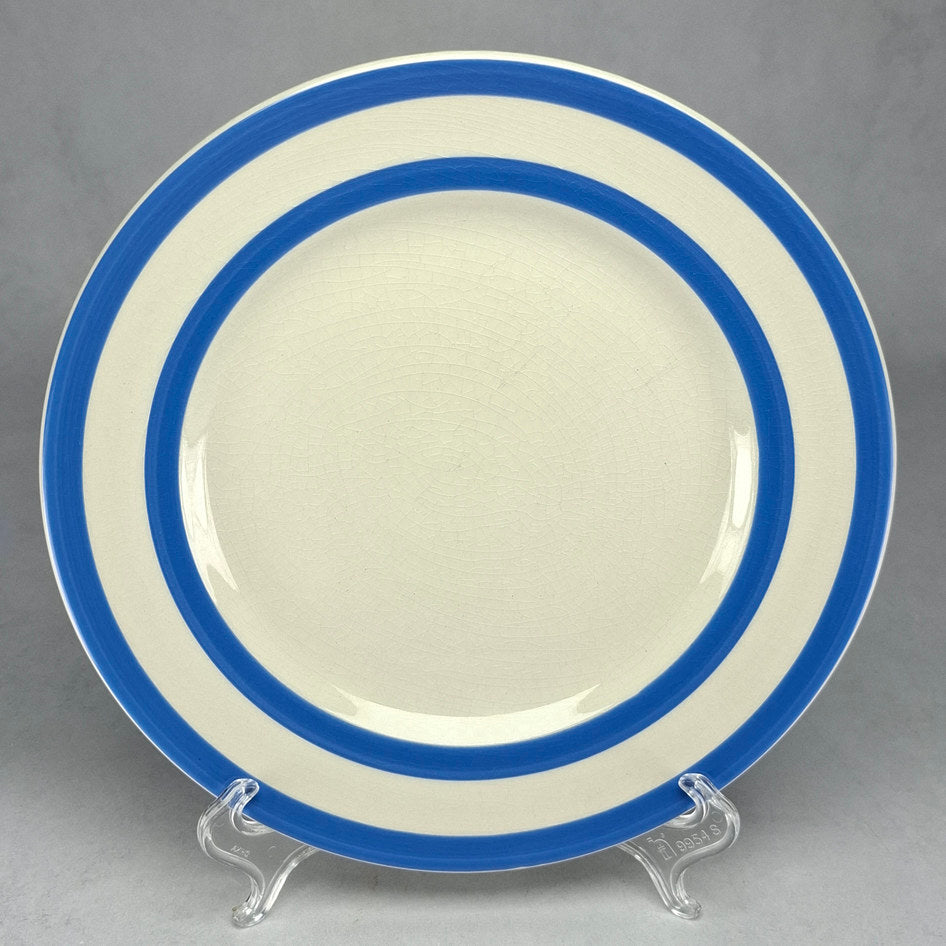
Few pieces of British kitchen pottery are as instantly recognisable as T.G. Green Cornishware. With its bold blue and white stripes, practical shapes and nostalgic kitchen charm, Cornishware has become one of the most loved and collected names in 20th century English domestic ceramics. Browse the Blues and Whites collection at Collectibles by Deon to see blue and white pieces currently available, or explore the wider ceramics collection for related English pottery.
For many collectors, Cornishware is more than attractive pottery. It represents a period when kitchens were organised around named storage jars, mixing bowls, sifters, jugs, rolling pins and practical everyday wares. These were objects made to be used, but their clean striped design has given them lasting decorative appeal.
The origins of T.G. Green
T.G. Green was founded in 1864 when Thomas Goodwin Green purchased a pottery at Church Gresley in Derbyshire, England. For many years, the pottery produced practical kitchen and table wares such as mixing bowls, teapots and everyday earthenware. These were useful household items, made for kitchens that needed reliable and affordable pottery. Cornishware later became the company's most famous design. Although the name suggests Cornwall, the original wares were made in Derbyshire. The Cornish name came from the visual association of the blue and white stripes with the Cornish seaside.
The birth of Cornishware
Cornish Kitchen Ware, later widely known as Cornishware, developed during the early 20th century. The design became famous for its horizontal blue and white bands, created by applying blue slip to the pottery and then turning the piece on a lathe to remove bands of the blue slip, revealing the white ceramic body underneath. A clear glaze was then applied to seal the surface and make the ware suitable for kitchen use. This method gave Cornishware its crisp striped appearance. The result was simple, fresh and highly distinctive. The blue and white colours were said to remind a T.G. Green employee of Cornish skies and white-crested waves, and that story became part of the charm of the range.
Why the blue and white design became iconic
The genius of Cornishware lies in its simplicity. The stripes are bold but not fussy. The colours are cheerful but not loud. The design works on small spice jars, large storage jars, bowls, plates, jugs and kitchen accessories. Blue and white has always had strong appeal in ceramics, from Chinese porcelain to Delftware and English transferware. Cornishware brought that appeal into the modern domestic kitchen in a practical, graphic and instantly recognisable way. It could sit comfortably in a country kitchen, a seaside cottage, a farmhouse display, a modern white kitchen or a collector's cabinet.
What makes original T.G. Green Cornishware collectable?
Original T.G. Green Cornishware is collectable because it combines design history, everyday usefulness and strong nostalgia. Many pieces were used daily, so surviving examples in good condition have real collector appeal. Storage jars in particular are highly sought after, especially those with named ingredients. Collectors often look for original T.G. Green marks, early backstamps, named storage jars, rare or less common ingredient names, complete jars with correct lids, good condition, strong blue colour, crisp white bands, useful display shapes, unusual forms and pieces with honest age and character.
The current collection includes the T.G. Green Original Cornish Kitchen Ware Blue and White Dinner Plate, the T.G. Green Original Cornish Kitchen Ware Blue and White Side Plate and the T.G. Green Cornish Kitchen Ware Blue and White Cereal Bowl, all good examples of the classic striped design in tableware form.
Named storage jars and rarity
Named storage jars are one of the most popular Cornishware collecting areas. Common names such as Sugar, Tea, Coffee, Flour and Salt are easier to find because they were useful in many households. Less common names can be more desirable because fewer were made or fewer have survived. Collectors may look for names such as Cloves, Mustard, Almonds, Brown Sugar, Apricots, Mace, Custard Powder, Nutmegs, Suet, Bath Salts or other more unusual examples. Some names were special orders, meaning they may appear far less often. Because T.G. Green did not keep a complete list of every custom name produced, some unusual jars are especially interesting to collectors. The safest wording is to describe a jar as common, less commonly encountered, unusual or sought after, depending on the name and evidence.
Backstamps and dating
Backstamps are very important when collecting Cornishware, but they should be interpreted carefully. Different backstamps were used over overlapping periods, so a backstamp alone does not always give an exact date. However, it can help place a piece within a broad production period. Collectors often look for early T.G. Green marks, black shield marks, green shield marks, church-style marks and later Judith Onions period marks. The black shield mark is especially associated with many named storage jars from the 1930s to 1950s. Because marks can be complex, it is best to record the exact backstamp shown on each item and avoid giving an exact year unless the mark and form clearly support it.
Judith Onions and later Cornishware
In the late 1960s, designer Judith Onions helped modernise the Cornishware range. Her designs refreshed the shapes and gave the range a more modern profile. These later pieces have their own collector following, especially when they are early examples from that redesign period. Collectors often separate earlier T.G. Green Cornishware from later Cornishware because the shapes, marks and production periods can differ. Both can be collectable, but the earliest and original period pieces are often the most sought after by serious collectors.
Original Cornishware versus Cornishware-style
Because the blue and white striped look is so recognisable, many other makers and modern producers have created similar striped kitchenware. Original T.G. Green Cornishware should have supporting marks, correct form, appropriate weight, proper decoration and collector-recognised features. Cornishware-style pieces may look similar but are not the same from a collecting point of view. For product descriptions, accurate wording builds trust: T.G. Green Cornishware where the mark supports it, original T.G. Green Cornish Kitchen Ware where appropriate, Cornishware-style where the piece is similar but not confirmed, and blue and white striped kitchenware, where no attribution is possible. Avoid calling an unmarked piece original T.G. Green unless there is strong supporting evidence.
How to identify genuine T.G. Green Cornishware
Start with the base. Look for the maker's mark, country of origin wording, pattern name, shield mark, church mark or other backstamp. Next, examine the form. Original Cornishware shapes have a particular feel and proportion. Then look at the stripe quality. Original Cornishware has bands created as part of the production process rather than simple painted stripes. Also check the lettering on named jars. The style, placement and quality of the lettering can help support age and authenticity. Finally, assess the condition. Genuine Cornishware was made for use, so signs of honest age are common. However, damage, replacement lids and heavy staining should always be noted.
Beware of fakes and incorrect attributions
Cornishware's popularity has led to fakes and misleading listings. Some fake marks are known, and incorrect backstamps are one of the main warning signs. Be cautious of pieces that look too new, have suspicious marks, poor proportions or lettering that does not match known examples. Also be careful with pieces described as rare without evidence. A common named jar in poor condition should not be presented as rare simply because it is old. Collectors should buy from sellers who provide clear photographs of the front, base, backstamp, lid and condition details.
Condition issues to check
Cornishware was kitchenware, so condition is very important. Check for chips, cracks, crazing, staining, lid damage, replacement lids, rim damage, handle cracks, interior staining, dark patches in the earthenware body, paint loss to lettering, wear around shaker holes and restoration. Because storage jars often held food ingredients, staining can occur inside the jar or under the glaze. Lids are also important. A correct original lid adds collector value, while a replacement lid should be disclosed. For sifters, shakers and dredgers, check holes, rims and handles carefully.
How to display Cornishware
Cornishware displays beautifully because the blue and white stripes create a strong visual rhythm. A row of named storage jars on a shelf can become the centrepiece of a vintage kitchen display. Mixing bowls and jugs can be grouped by size. Smaller spice jars can be arranged together for a charming collector's grouping. Cornishware pairs well with blue and white transferware, white ironstone, enamel kitchenware, wooden shelves, vintage scales, glass storage jars, farmhouse ceramics, copper and brass kitchen pieces, creamware and stoneware. For a cleaner look, display a few pieces with space around them. For a fuller collector's look, group jars closely together by size or name.
Why Cornishware remains timeless
T.G. Green Cornishware remains timeless because it combines utility, design and memory. It was made for ordinary kitchens, yet it has become a design classic. Its blue and white stripes are instantly recognisable, and its named storage jars continue to appeal to collectors around the world. Whether you are adding one jar to a shelf or building a full blue and white kitchenware collection, Cornishware is a collecting field with lasting appeal.
If you enjoy English ceramics and collector guides, you may also find our articles on Aynsley Pembroke Bone China: History, Design and Collector Appeal and Lucia Ware: A Collector's Guide to South African Mid-Century Pottery of interest.
Browse the ceramics collection and latest additions for English kitchenware and blue and white pieces as they come in. For enquiries about specific pieces or availability, visit the Contact page, or learn more about the store.