
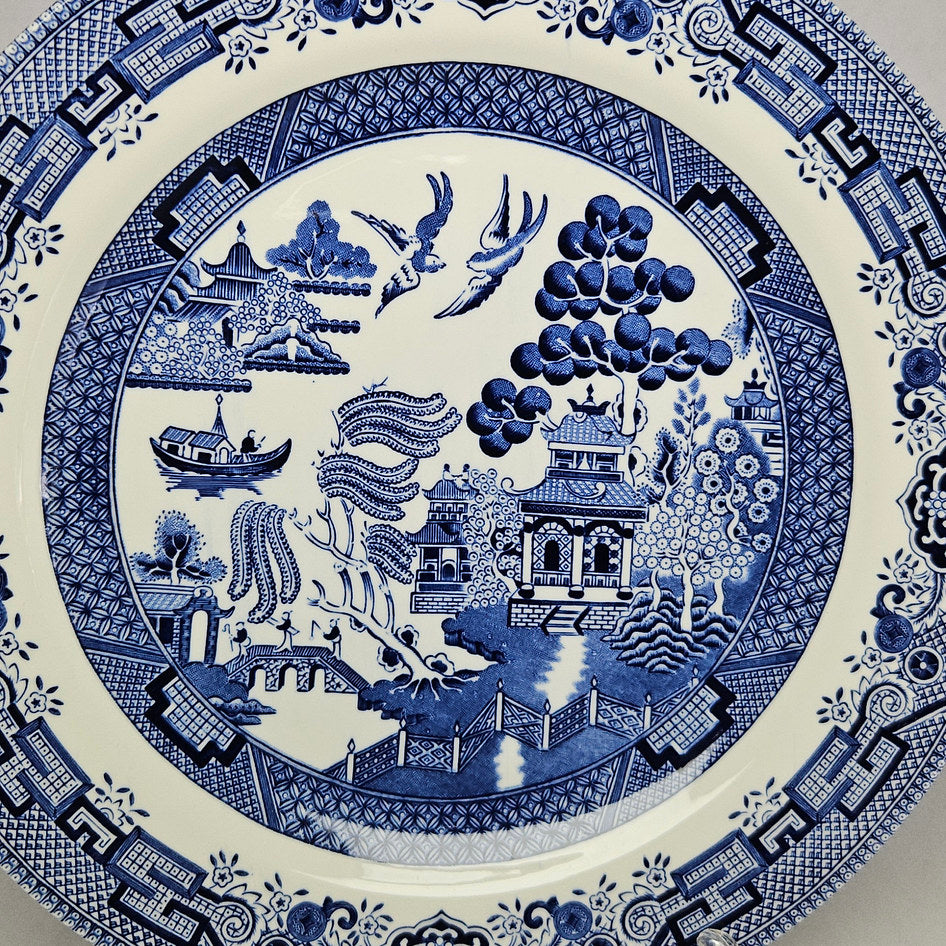
If you have ever eaten off a blue and white plate decorated with a willow tree, a bridge, and two birds in flight, you have eaten off transferware. It is one of the most enduring and widely collected categories of British pottery, and for good reason. The patterns are beautiful, the history is fascinating, and pieces turn up regularly at South African antique markets, estate sales, and charity shops, often at prices that still make sense for the careful collector.
This guide explains what transferware is, how it was made, the key patterns you will encounter, and what to look for when building a collection.
What Is Transferware?
Transferware is pottery decorated using a transfer printing process, in which a design is engraved onto a copper plate, inked with a ceramic pigment, and then transferred onto tissue paper. The tissue paper is pressed onto the surface of the unfired or bisque-fired pottery; the paper is removed, and the design is left behind on the clay. The piece is then glazed and fired, fusing the decoration permanently into the surface.
The process was developed in Britain in the mid-eighteenth century and allowed potteries to produce consistently decorated wares at a scale and price that hand-painting could not match. It transformed the British ceramics industry and made decorated tableware accessible to a much wider market. The Staffordshire potteries in particular became the centre of transferware production, and the term "Staffordshire transferware" is widely used by collectors to describe the broad category of British printed pottery.
How to Identify Transferware
Transferware can be identified by several characteristics:
- Printed decoration: the design is applied as a single colour print, most commonly blue, but also red, brown, green, black, and purple. The decoration has a consistent, slightly mechanical quality compared to hand-painting, though early transfer prints can show fine detail and variation.
- Pattern repeat: because the design comes from an engraved plate, the same pattern appears consistently across a set of pieces, though minor variations occur as the tissue paper stretches or the print wears.
- Underglaze decoration: most transferware is decorated under the glaze, meaning the design is protected by the glaze layer and does not wear off with normal use.
- Maker's marks: most British transferware carries a maker's mark on the base, often including the pattern name, the maker's name or initials, and sometimes a country of origin mark. "Made in England" marks indicate production after 1891, when the McKinley Tariff Act required country of origin marking on goods exported to the United States.
Blue Willow: The Most Collected Transferware Pattern
The Blue Willow pattern is the most widely produced and collected transferware design in the world. It depicts a Chinese-inspired landscape featuring a willow tree, a bridge with figures, a pavilion, a boat, and two birds in flight. Despite its Chinese appearance, the pattern is entirely a British invention, developed in the Staffordshire potteries in the late eighteenth century. The most commonly cited origin is Spode, who produced an early version of the pattern around 1790, though the exact origins are debated among ceramic historians.
The pattern was produced by virtually every major British pottery and many overseas manufacturers, making it one of the most widely available transferware patterns for collectors. The Collectibles by Deon Blue Willow collection includes examples from several of the key British makers:
- Churchill: one of the longest-running producers of Blue Willow, still in production today. Churchill pieces in the collection include the Churchill Blue Willow Tall Ceramic Tea Mug, the Churchill Blue Willow Ceramic Tea Cup and Saucer, the Churchill Blue Willow Ceramic Side Plate, and the Churchill Blue Willow Ceramic Sugar Bowl.
- EIT England (Empire Industries): a Staffordshire maker whose Blue Willow pieces are well regarded by collectors. EIT examples in the collection include the EIT England Blue Willow Ceramic Dessert Bowl, the EIT England Blue Willow Ceramic Tea Cup and Saucer, and the EIT England Blue Willow Ceramic Side Plate.
- Wood and Sons: a long-established Burslem pottery whose Willow pattern pieces are consistently collectable. The Wood and Sons Woods Ware Willow Blue and White Dinner Plate and the Wood and Sons Woods Ware Willow Blue and White Handled Cake Plate are good examples.
- Booths: known for the "Real Old Willow" pattern, a version of Blue Willow with a distinctive border and fine engraving quality. The Booths Real Old Willow Blue and White Food Warmer Bowl is a particularly useful and collectable form.
- Royal Doulton: produced Blue Willow as part of its broad tableware range. The Royal Doulton Blue Willow Ceramic Milk Jug in the collection is a good example of the Doulton version of the pattern.
- Burleigh Ware: Burgess and Leigh, trading as Burleigh, produced a well-regarded Willow pattern. The Burleigh Ware Willow Blue and White Rectangular Handled Serving Tray is an unusual and practical form.
Red Willow and Other Colour Variants
While blue is by far the most common colour for Willow pattern transferware, the pattern was also produced in red, brown, green, and black by various makers. Red Willow is the most actively collected colour variant after blue. The W.T. Copeland and Sons Red Willow Chinoiserie Transferware Plate in the Blue Willow collection is a documented example of this rarer colour variant from one of the most respected Staffordshire makers. W.T. Copeland and Sons, later trading as Spode, is one of the foundational names in British transferware.
Norfolk Blue and Other Transferware Patterns
Beyond the Willow pattern, transferware collectors encounter a wide range of other printed designs. The Royal Doulton Norfolk Blue D4209 Scalloped Plate in the Blues and Whites collection is a good example of a non-Willow transferware pattern. The Norfolk Blue pattern features a landscape design with a distinctly English pastoral character, quite different from the Chinese-inspired Willow. The D4209 pattern number is a documented Royal Doulton reference that helps collectors identify and date the piece.
Red transferware beyond the Willow pattern is also collectable. The Jones and Middleton The Original Staffordshire Red Transferware Oval Platter in the collection is a good example of red printed Staffordshire ware, with the bold red print and oval platter form that characterise the better Staffordshire serving pieces.
What to Look For When Collecting Transferware
- Pattern quality: look for crisp, well-registered prints with good detail. On older pieces, minor smudging or variation in the print is normal and does not necessarily detract from value, but heavy blurring or misregistration reduces desirability.
- Maker's marks: always check the base. A clearly marked piece from a known maker is more desirable than an unmarked example. Pattern names on the base are a bonus, as they help with identification and dating.
- Condition: chips, cracks, and crazing all affect value. Transferware is functional pottery and many pieces show use wear, particularly on rims and bases. Assess condition carefully in good light.
- Completeness of sets: complete sets of transferware, particularly tea services and dinner services, are increasingly rare and command premiums. Individual pieces are more commonly found and are a practical starting point for new collectors.
- Age indicators: "Made in England" marks indicate post-1891 production. "England" alone suggests production between approximately 1891 and 1921. Pieces marked "Staffordshire England" or with a pattern name and maker's mark but no country mark may be earlier, though this requires careful assessment.
Transferware in South Africa
British transferware arrived in South Africa in significant quantities through the colonial period, when British-made pottery dominated the domestic market. Blue Willow in particular was a staple of South African households from the late nineteenth century onward, and pieces turn up regularly at estate sales, antique markets, and charity shops across the country. Complete sets are rare, but individual plates, cups, and serving pieces are still found at accessible prices.
The Collectibles by Deon Blue Willow collection brings together a curated selection of transferware from the key British makers, with each piece described and verified. You are also welcome to explore the Blues and Whites collection for further blue and white printed pottery, or browse all ceramics. For questions about specific patterns or makers, visit our contact page or learn more about the store.
Frequently Asked Questions
What is transferware?
Transferware is pottery decorated using a transfer printing process, in which a design is engraved onto a copper plate, inked with a ceramic pigment, transferred onto tissue paper, and then applied to the pottery surface before glazing and firing. The process was developed in Britain in the mid-eighteenth century and allowed consistent, affordable decorated pottery to be produced at scale.
Is Blue Willow always made in England?
No. The Blue Willow pattern has been produced by potteries in many countries, including the United States, Japan, and other European nations, as well as Britain. British-made Blue Willow from documented makers such as Churchill, Burleigh, Wood and Sons, and Booths is generally the most sought after by collectors.
What does the Blue Willow pattern represent?
The Blue Willow pattern depicts a Chinese-inspired landscape with a willow tree, a bridge with figures, a pavilion, a boat, and two birds in flight. Despite its Chinese appearance, it is a British invention developed in the Staffordshire potteries in the late eighteenth century. A romantic legend about the pattern involving two lovers is a later invention and is not part of the original design history.
How do I date a piece of transferware?
Maker's marks are the most reliable dating tool. "Made in England" marks indicate production after 1891. "England" alone suggests approximately 1891 to 1921. Pattern numbers and maker's marks can be cross-referenced against ceramic reference books and online databases. The style of the mark itself often provides additional dating clues.
What is the difference between Blue Willow and Real Old Willow?
"Real Old Willow" is a specific version of the Blue Willow pattern produced by Booths (later Royal Doulton), characterised by a distinctive border design and fine engraving quality. It is one of the most respected versions of the pattern among collectors.
Is Red Willow rare?
Red Willow is significantly less common than Blue Willow and is actively sought by collectors who specialise in colour variants of the pattern. It was produced by several makers including W.T. Copeland and Sons, but in much smaller quantities than the blue version.
A rewarding category for collectors of Blue Willow pottery, blue and white ceramics, or British printed pottery with a documented maker history. Browse the Blue Willow collection to explore available pieces, or contact us to ask about specific patterns or makers.