
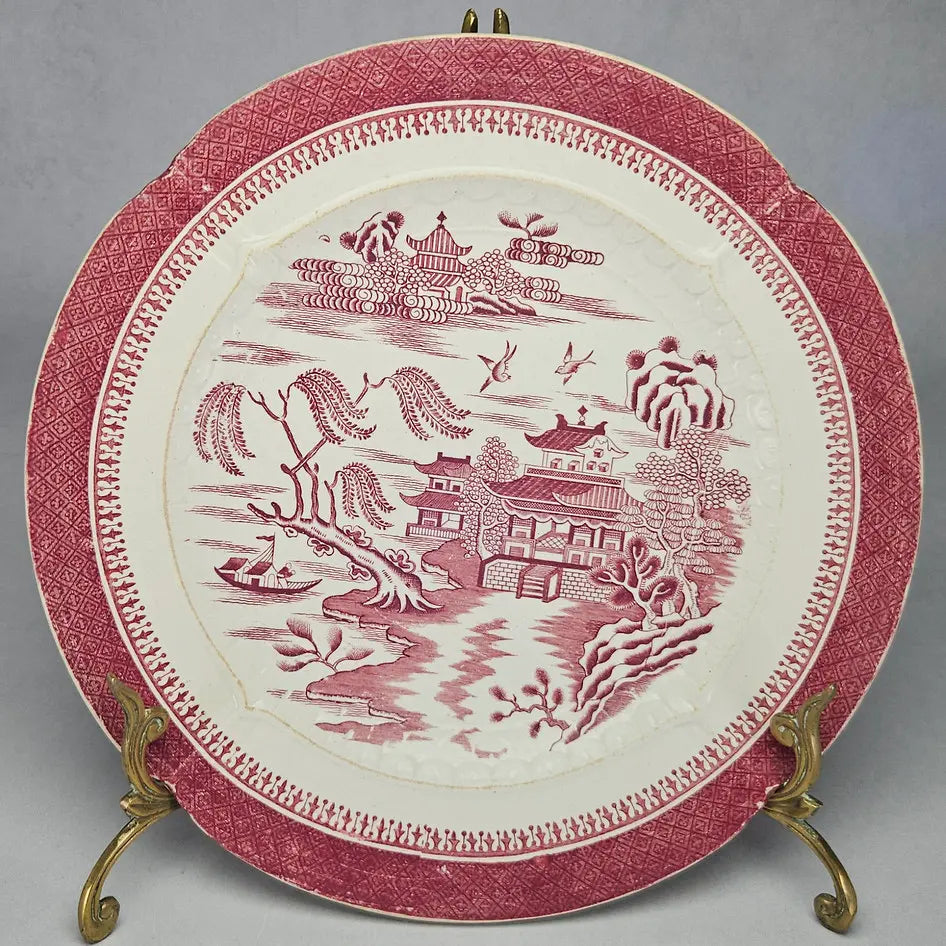
Spode is one of the most important names in English ceramics, with a history stretching back to 1770 when Josiah Spode I established his pottery in Stoke-on-Trent. For collectors, Spode offers three distinct and rewarding collecting categories: Blue Italian transferware, the broader range of Copeland-period transferware, and Spode and Copeland bone china. Each category has its own collector community, its own mark system, and its own particular pleasures.
A Brief History of Spode and Copeland
The Spode factory was established by Josiah Spode I in 1770 and passed to his son Josiah Spode II, who is credited with refining the bone china formula around 1800. The factory was acquired by W.T. Copeland and Thomas Garrett in 1833, trading as Copeland and Garrett until 1847, then as W.T. Copeland and Sons until 1970, when the Spode name was revived. The factory was acquired by the Portmeirion Group in 2009, which continues to produce Blue Italian and other Spode patterns under the Spode name.
Blue Italian
Blue Italian is the most celebrated and widely collected Spode pattern. Introduced around 1816, it features a romantic Italian landscape scene printed in underglaze blue on a white earthenware body. The pattern has been in continuous production since its introduction, making it one of the longest-running ceramic patterns in the world. The quality of the engraving, with its characteristic stippled shading in the landscape elements, is finer and more detailed than most copies and imitations.
Blue Italian was produced across a wide range of tableware forms, including dinner plates, side plates, soup bowls, serving dishes, tureens, teapots, cups and saucers, and storage jars. Collectors often focus on building a complete service or on collecting unusual or larger serving pieces. The Blues and Whites collection at Collectibles by Deon includes Blue Italian pieces when available.
Red Willow and Colour Variants
Red Willow is a colour variant of the Blue Willow pattern, printed in red rather than blue. It was produced by several Staffordshire manufacturers including W.T. Copeland and Sons, but in much smaller quantities than the blue version. The Copeland Spode Red Willow Pattern Dinner Plate is a documented example of this less common variant, with the Copeland backstamp confirming its factory origin. Red Willow is significantly less common than Blue Willow and is actively sought by collectors who specialise in colour variants of the pattern.
Copeland Bone China and Tableware
Beyond transferware, the Spode and Copeland factory produced a wide range of bone china tableware across its history. The Copeland Spode Italian Blue and White Tea Cup and Saucer is a classic example of the Blue Italian pattern in a bone china tea form, with the Copeland backstamp placing it in the factory's long Copeland-period production. Copeland bone china pieces are collected alongside the transferware for their quality and their connection to the factory's history.
What to Look For When Collecting
The backstamp is the starting point for any Spode or Copeland piece. The mark progression from Spode through Copeland and Garrett, W.T. Copeland and Sons, and back to Spode is well documented and allows pieces to be dated with reasonable confidence. For Blue Italian, assess the quality and sharpness of the transfer print, the depth of the cobalt blue, and the condition of the glaze and body. For bone china, look at the quality of the gilding and the clarity of any painted decoration.
Spode and Copeland in South Africa
Spode and Copeland pieces reached South Africa through British household imports and the general trade in English ceramics. Blue Italian in particular was widely used in South African homes through the mid-twentieth century, and pieces turn up regularly at estate sales and auction houses. Red Willow is less commonly encountered and attracts stronger collector interest when it does appear.
A rewarding category for collectors of blue and white ceramics, transferware, or British fine china with a documented factory history. Browse the Ceramics collection to explore available pieces, or contact us to ask about specific patterns or marks. Learn more about the store and how each piece is sourced.
Frequently Asked Questions
Did Spode invent bone china?
Josiah Spode II is widely credited with refining the bone china formula around 1800, creating the body type that became the standard for British fine ceramics. While earlier experiments with bone ash in ceramic bodies existed, Spode's formula, combining bone ash, china clay, and china stone in specific proportions, was the version adopted by the British ceramics industry.
Is Blue Italian still being made?
Yes. Blue Italian has been in continuous production since its introduction around 1816, making it one of the longest-running ceramic patterns in the world. It is currently produced by the Portmeirion Group, which acquired the Spode factory in 2009, under the Spode name.
What is the difference between Spode and Copeland?
Spode and Copeland refer to the same factory at different periods of its history. The factory was established by Josiah Spode I in 1770 and traded as Spode until 1833, when it was acquired by W.T. Copeland and Thomas Garrett. It traded as Copeland and Garrett (1833 to 1847), then as W.T. Copeland and Sons (1847 to 1970), before the Spode name was revived in 1970. The factory was acquired by the Portmeirion Group in 2009.
How do I identify genuine Spode Blue Italian?
Check the base for the Spode or Copeland backstamp. Genuine Spode Blue Italian has fine, detailed engraving with characteristic stippled shading in the landscape elements. The quality of the print is finer and more detailed than most copies. The mark should be consistent with the claimed period of production.
What is Red Willow?
Red Willow is a colour variant of the Blue Willow pattern, printed in red rather than blue. It was produced by several Staffordshire manufacturers including W.T. Copeland and Sons, but in much smaller quantities than the blue version. Red Willow is significantly less common than Blue Willow and is actively sought by collectors who specialise in colour variants of the pattern. Read our guide to transferware and Blue Willow for more detail.
A rewarding category for collectors of blue and white ceramics, transferware, or British fine china with a documented factory history. Browse the Ceramics collection to explore available pieces, or contact us to ask about specific patterns or marks. Learn more about the store.