
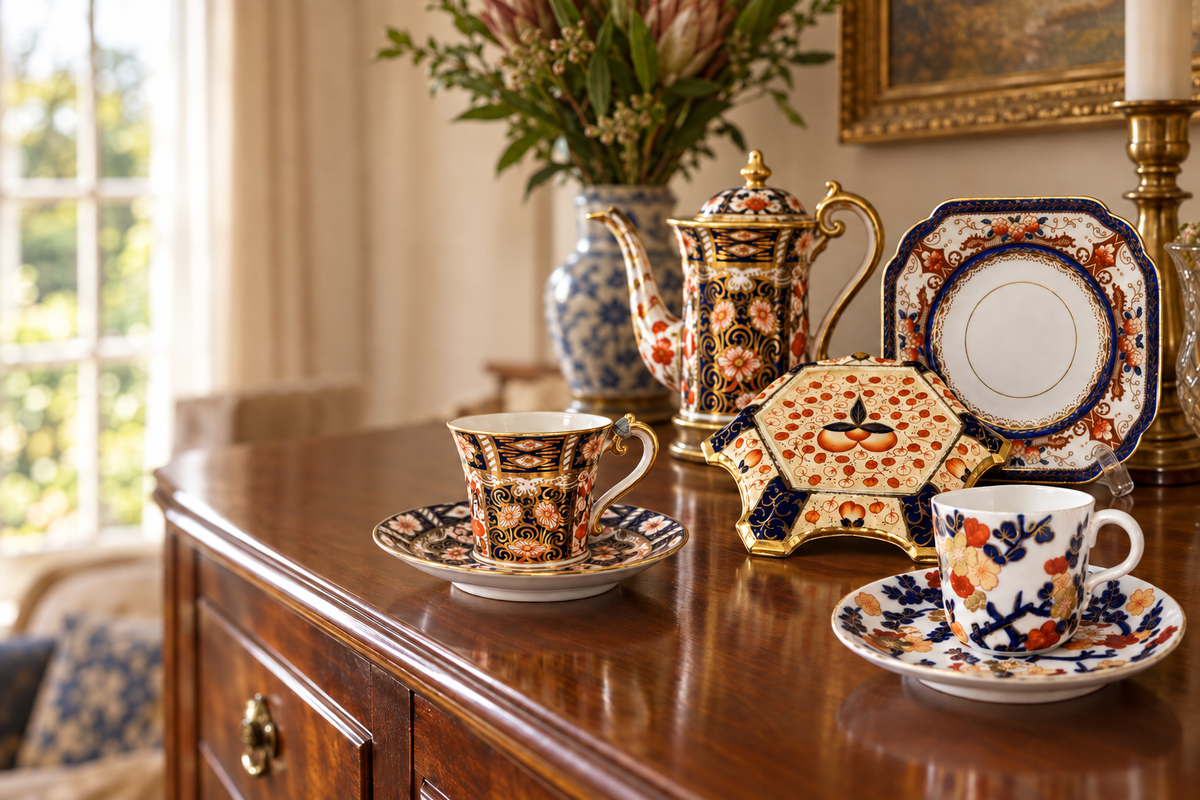

Look inside a cabinet of English bone china collected over a few generations and you may well spot a saucer that looks nothing like the others. Instead of soft English florals, it has deep cobalt blue panels, iron-red flowers and bright gilding, all laid out in a rich, formal pattern. This is Imari, a style borrowed from Japan that has stayed popular in European ceramics for centuries. Royal Crown Derby has been painting its own versions for more than two hundred years, and its Imari pieces are still some of the most recognisable and sought-after the factory has ever made.
How the Factory Began
Royal Crown Derby's story begins around 1750, when André Planché, a Huguenot modeller, started making porcelain figures in Derby. A few years later, he teamed up with William Duesbury, a porcelain decorator, and John Heath, a banker. Most historians see this partnership, made official in the mid-1750s, as the real start of the Derby china works.
Duesbury later bought the Chelsea and Bow factories and brought their skilled workers into the Derby business. By 1773 or 1775 (sources disagree on the year), King George III's patronage had given the company the right to add a crown to its backstamp. The word "Royal" came much later. In 1890, Queen Victoria named the firm Manufacturers of Porcelain to Her Majesty.
Over the years, the factory has worked from three addresses: Nottingham Road, then King Street, and from 1877, Osmaston Road, where it still is today.
How a Japanese Port Ended Up on English Teacups
The pattern didn't start in Derby, or even in Europe. Its story begins in Arita, in Japan's Hizen province, where potters found good porcelain clay in 1616. A porcelain industry grew up there almost overnight. Pieces from Arita's kilns were carried overland to Imari, a nearby coastal town, and shipped from there to the Dutch and Chinese trading posts at Nagasaki, ready for export to Europe.
The porcelain received its name from the port. What set Imari apart was its colours: cobalt blue under the glaze, with iron-red and gold added on top. These were arranged in busy, balanced panels of flowers, fans and repeating diamond patterns called diaper-work. Gold was much easier to come by in Japan than in China at the time, so Japanese export pieces had a richness that Chinese blue-and-white porcelain usually didn't.
European buyers loved it. Porcelain designs had no copyright protection in the 18th century, so factories simply copied whatever sold. Meissen, Chantilly, Vincennes and Vienna all made their own Imari-style ranges, and in England, Worcester and Derby did the same. By the early 1800s, the English versions were usually just called "Japan patterns."
Robert Bloor, who took over the lease of the Derby factory in 1815, took these patterns further than anyone. He had hand painters decorate large amounts of slightly flawed white china, known as factory seconds, in bold Imari colours, then sold the results at auction for a good profit. This is a big part of why Derby and Imari are still so closely linked today.
One pattern from this tradition has lasted especially well. Pattern 1128, "Old Imari," was entered in the Royal Crown Derby pattern books in 1882 and is still made today. That makes it one of the longest-running patterns in the history of English ceramics.
Reading a Backstamp: How to Roughly Date a Piece

Royal Crown Derby's marks changed each time the business changed hands, so learning their order is the most useful skill for working out when a piece was made. Early Nottingham Road pieces, made from the 1750s to 1848, carry hand-painted crowns or "D" monograms, and from 1806, red-painted crown marks. In Robert Bloor's later years, the factory began using printed marks in a gothic style.
When the original factory closed in 1848, some of its former workers carried on making porcelain nearby on King Street. After several different partnerships, the business settled as Stevenson & Hancock. Its mark shows a crown above crossed batons, with the letters "S" and "H" on either side and a "D" below. This mark was used until 1935. Collectors value it highly because it links directly back to the original Georgian workforce, who carried on working from the original moulds.
Meanwhile, the modern company built its Osmaston Road factory in 1877 and brought in its own mark: a crown above two linked "D"s. Over the following decades, it added "England" and later "Made in England" as export rules required.
Once you know which period mark you're looking at, the small symbol printed or painted underneath it can give you a more exact date. From 1880 to 1937, Royal Crown Derby used a series of simple symbols, such as dots, crescents, diamonds and small crosses, with a different one for each year. With a reference chart, anyone can use these to date a piece to within a year or two. From 1938, the factory switched to Roman numerals for the year, and you'll still see these on pieces made today.
Working out a date this way is useful and satisfying detective work, but it's worth being careful. A date mark tells you when a piece was decorated, not how rare or valuable it is. Reproduction and revival marks also exist, so always check the chart against the piece's overall condition and quality.
Imari Wasn’t Only a Derby Story

Imari-style wares were made, in varying quality, across the English potteries for well over a century. A wider collection built around the palette rather than one maker alone can be just as satisfying to put together. Coalport, Davenport, Mayer & Sherratt, and Taylor & Kent, among many others, all produced their own cobalt-and-iron-red interpretations, sometimes closely following Japanese originals and sometimes drifting into their own floral variations.

A Davenport teapot stand attributed to the early Victorian period, for instance, carries the same orange-fruit-and-cobalt-panel arrangement as a Derby saucer twice its age, just rendered by a different hand.

A Mayer & Sherratt “Melba” side plate or a Taylor & Kent tea saucer shows the pattern scaled down and squared off for a later, more modest tea service.
Smaller or lesser-documented names, from Alfred B. Pearce of London to the English maker Flosmaron, produced their own cheerful, less formal cobalt-and-iron-red cups and saucers for the everyday market rather than the display cabinet.
The King Street successor firm continued producing Derby-marked Imari long after the original factory’s 1848 closure under the Stevenson & Hancock mark, which is why “Derby Imari” pieces exist from several different makers, marks, and eras under closely related names. For a new collector, these related makers are a genuinely useful entry point: the palette and the visual grammar (panelled borders, dense floral fill, a warm red against cobalt and gold) are consistent enough across factories that pieces mix well on a shelf or table setting, even when their marks tell very different stories about where, and when, they were actually made.
Building a Collection

With Imari, collectors often focus on the pattern number as much as the maker. Royal Crown Derby alone has produced hundreds of named and numbered Imari variants since the 19th century, from the long-running Old Imari (1128) to the equally popular Traditional Imari (2451), so two pieces marked “Royal Crown Derby Imari” can look meaningfully different depending on which pattern they carry.
Look closely at the quality of the gilding, the crispness of the painted panels, and the backstamp period before assuming two pieces are a matched pair, and don’t be afraid to build a collection that mixes Derby with its Staffordshire contemporaries; the pattern’s three-hundred-year habit of getting copied is, in its own way, part of the story worth collecting.
Browse the Royal Crown Derby collection at Collectibles by Deon, including several pieces in the Traditional Imari (2451) pattern, or explore our wider selection of Imari-style cups, saucers and side plates from Coalport, Davenport, Alfred B. Pearce, Mayer & Sherratt, Taylor & Kent and more. Questions about a particular piece are welcome through the contact page, and the about page tells the story of the shop.
Sources
- Wikipedia, “Royal Crown Derby”: https://en.wikipedia.org/wiki/Royal_Crown_Derby
- Wikipedia, “Imari ware”: https://en.wikipedia.org/wiki/Imari_ware
- Royal Crown Derby, “Our Heritage” (official company history): https://www.royalcrownderby.co.uk/royal-crown-derby-heritage/
- Royal Crown Derby, “Historic Backstamps” (official marks and dating guide): https://www.royalcrownderby.co.uk/historic-backstamps/
- Antique Marks, “Derby Marks and Dating Royal Crown Derby Porcelain”: https://antique-marks.com/derby-marks.html
- Museum Crush, “Unlocking the secrets and origins of Imari Crown Derby porcelain”: https://museumcrush.org/unlocking-the-secrets-and-origins-of-imari-crown-derby-porcelain/
- William Bemrose, Bow, Chelsea and Derby Porcelain (London, 1898), Derby marks chart, public domain via Wikimedia Commons: https://commons.wikimedia.org/wiki/File:Derby_Marks.jpg
- Photo by tjabeljan (Jan Kruithof), “2014-08-04 Okawachiyama”, via Wikimedia Commons (CC BY 2.0): https://commons.wikimedia.org/wiki/File:2014-08-04_Okawachiyama.jpg