
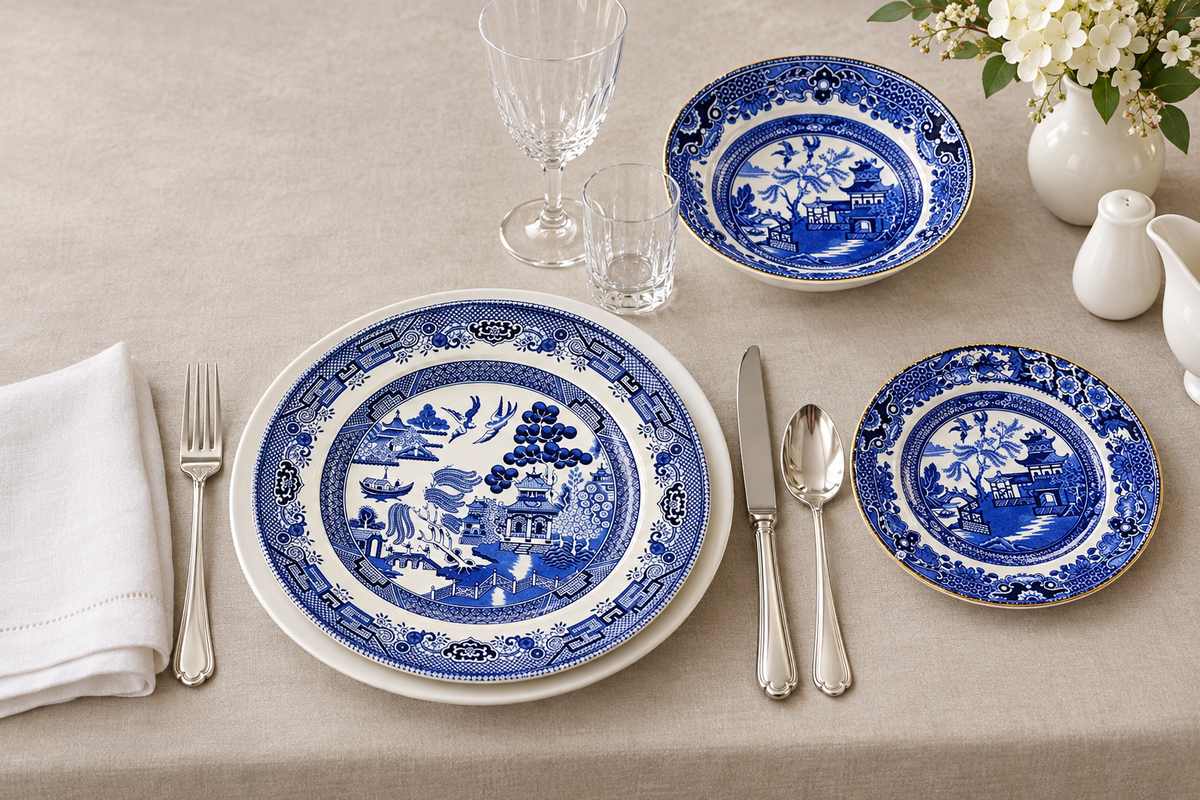
While the romantic legend of Koong-se and Chang adds to the mystery of Blue Willow, the documented history of this classic blue and white transferware is even more interesting. Although its oriental scenery suggests Chinese origins, the design was developed in England from Chinese export porcelain. Add a disputed engraver credit, a small Shropshire factory and the famous story of two star-crossed lovers, and it becomes clear why Blue Willow pieces from different makers can look so different.

How Blue Willow Began in England
The late 18th century was dominated by Chinese export porcelain which did not simply sit on the table, it moved the world around it. It changed how people ate, drank and decorated their homes almost everywhere it reached. The high demand for these products significantly affected the European economy, and the only way a small factory could compete with genuine imported porcelain was to experiment and create its own wares.
Around 1772, Thomas Turner, an English potter, joined Ambrose Gallimore, a nephew of the founder of Coalport china, at the Caughley works in Shropshire. Turner had trained at the Worcester Porcelain Manufactory, where he learned transfer printing directly. In 1775, the engraver Robert Hancock, one of the most celebrated engravers of the period, joined Caughley from Worcester. It was against this background, sometime in the early 1780s, that the classic Willow pattern started taking shape.
Who Actually Engraved Blue Willow?
Accounts of the original engraving genuinely diverge. Many collector references credit Thomas Minton, who worked as an engraver before later founding his own famous pottery, with engraving the original pattern for Turner at Caughley. Other detailed histories of Caughley instead focus on Robert Hancock as the factory's principal engraver during this period and do not mention Minton's involvement there. The International Willow Collectors organisation credits Minton with designing and engraving the Standard Willow Pattern specifically for Spode, around 1790, rather than for Caughley in the 1780s. Without a marked or dated piece that provides a clear answer, there is no single account of the complete story.
What Happened to Caughley?
Turner ran the Caughley factory for more than two decades, but sold the works when his health deteriorated towards the late 1790s. Edward Blakeway and Richard and John Rose, the partners behind the Coalport porcelain works, continued producing blanks at the Caughley site until 1814, and the factory's equipment was finally moved to Coalport in 1821. Turner's name does not appear on most Willow pieces collectors find today, but without Caughley the pattern as it is known may never have existed.
Standard Willow Is One Pattern in a Larger Family
Strictly speaking, there is only one Standard Willow Pattern. It shows a willow tree leaning over a bridge with three figures, a three-pillared teahouse, often called a pagoda, a large fruit tree, an island with a boat and a man, two birds flying towards each other, a fence and usually two decorative borders.
Standard Willow is just one pattern in a much larger family of Chinese-inspired landscapes. Mixing up these related patterns is one reason Willow pieces can look so different from one maker to another.
Two Temples I is the earliest related pattern. It is essentially Caughley's original Broseley pattern, named after a Shropshire town near the Caughley factory. Engraved around 1780, it was a fairly direct copy of a Chinese porcelain design and appeared several years before the Standard Willow pattern.
Two Temples II, also called Broseley, is Spode's version of the same Caughley design, made under a different factory name. Mandarin is another related but separate pattern, which ceramics historian Robert Copeland believes directly influenced Willow. Canton is also a named relative and one of the ten main variants formally recognised by collectors today. Other recognised versions include patterns named after Booths and Burleigh.
So, when two pieces sold as Blue Willow look genuinely different, they are not necessarily poor copies of the same design. They may be different named patterns from the same wider family.
Three Examples from the Blue Willow Family
These three examples show why Blue Willow is best understood as a family of related patterns rather than one fixed design. They include a later Churchill charger, a related Swinnertons Blue Pagoda bowl and a Burleigh Ware Blue Willow side plate. The maker, form, border and printed scene all contribute to identification.

Queen’s by Churchill: This charger shows a later English interpretation of the Willow tradition. Its larger format and Churchill attribution make it a useful modern comparison when studying older Blue Willow pieces.

Swinnertons Olde Alton Ware: The Blue Pagoda name points to a related Chinese-inspired landscape rather than automatically proving that the bowl is Standard Willow. It demonstrates why the central scene should be considered alongside the backstamp, shape and border.

Burleigh Ware: This gilt side plate shows how a named maker and border treatment can help distinguish one Willow version from another. Burleigh's own Willow tradition can share broad design elements with other makers while remaining recognisable through its body, decoration and mark.
Why the Same Willow Design Appears Under Different Makers
Robert Copeland's research offers collectors an important warning. Potteries often bought, sold or lent their used engraved copper plates to one another, so the same printed design can appear on wares from different factories. Copeland says it is “virtually impossible” to identify the maker of an unmarked Willow-family piece from the pattern alone. The border and backstamp are usually more reliable clues than the central scene, which is why the maker differences below are important to understand.
Blue Willow Makers and Their Marks
Booths launched its own Real Old Willow at the end of the 19th century, marketed from the early 1900s and based on Spode's original composition. It can be identified by its gold-trimmed, scalloped edges and bow-knot border, rather than the plain double-line border used by most other makers. Handle treatment on jugs and cups shifted from blue underglaze with a single gold splash before 1912 to plain white with gilt detailing afterwards, a small detail that helps with rough dating.
Burleigh Ware, or Burgess and Leigh, was founded in 1851, with the Burleigh trademark adopted in the 1930s. Its Willow is known for an especially deep, inky cobalt printed against an off-white rather than pure white body. The company relaunched Willow in 2024, reproduced directly from its own surviving 19th-century engravings, so genuinely old and genuinely new Burleigh Willow can share the same design.
Royal Doulton's own tableware production traces to 1877, at the former Pinder, Bourne and Co. works in Burslem. Royal Doulton later absorbed Booths through a chain of mergers: Booths into Booth and Colclough in 1948, into Allied English Potteries in 1955 and finally under Royal Doulton Tableware Ltd from 1973. This history explains why Royal Doulton later produced its own Real Old Willow range from 1982 to 1999, continuing a pattern that originally began under another maker's name.
Wood and Sons was founded in Burslem in 1865 by Absalom Wood and his son Thomas. For decades, it produced Willow-pattern earthenware under the Wood's Ware trade name. The company was placed under the control of receivers in 1981 and closed completely in 1995. Because Wood and Sons is no longer trading, a confirmed piece can usually be dated more easily than one made by a factory that is still operating today.
Churchill traces its roots to 1795 in Stoke-on-Trent and is one of the few makers still producing Blue Willow today. Its modern wares are generally made in a durable earthenware body finished for dishwasher and microwave use, with bolder and more contemporary shaping than 19th-century originals. It is a useful, low-stakes way to compare an old and a new interpretation of the same design side by side.
EIT England is short for English Ironstone Tableware Ltd, a later 20th-century Staffordshire maker rather than a historic name tied to the pattern's original 18th-century story. This is a useful reminder that a maker's mark on a Blue Willow piece does not always belong to an old company. Dating should be based on the mark and the shape of the piece, not on assumptions about how old the pattern is.
How to Identify and Date Blue Willow Pieces
Blue Willow is not a single pattern. It is a family of related designs made by different factories. These factories changed over time, merged or closed, and often shared or resold the engraved plates used to print the designs.
This means that two pieces which look almost identical may have been made by different factories, decades apart. At the same time, pieces from the same maker may look quite different if they use another version of the pattern or were made during a different period in the factory's history.
That is why the backstamp and the ceramic body of each piece need to be examined carefully. With Blue Willow, this inspection is especially important. Compare the border, shape, handles, gilding, colour, body and mark with reliable examples from the same maker before assigning a date or attribution.
Why These Differences Matter to Collectors
Understanding the Willow family helps collectors avoid treating every variation as a mistake or every old-looking piece as an antique. A shared copper plate can explain why two factories produced similar scenes, while a different border, body or backstamp can show that the pieces were made decades apart.
For the legend, the standard design elements and what to check for condition and collectability, see the full Blue Willow Pattern: History, Meaning and Collector Appeal guide. Then browse the Blue Willow collection to compare Booths, Burleigh Ware, Churchill, Royal Doulton, Wood and Sons and EIT England pieces side by side.
Collectors can contact the shop with questions about a piece and learn more about Collectibles by Deon, its collecting focus and its approach to provenance.
Sources
- International Willow Collectors, “What Is Willow”.
- Patricia M. Samford, review of Robert Copeland's Spode's Willow Pattern and Other Designs After the Chinese, Ceramics in America 2001, Chipstone Foundation.
- thepotteries.org, “Booths Ltd”.
- Wikimedia Commons, “Plate (AM 13421-1).jpg”, porcelain blue and white “the Willow Pattern” plate made for the export market, unknown author, Qianlong period, 1736 to 1795, Qing dynasty, late 18th century, licensed under Creative Commons Attribution 4.0.
- Queen’s by Churchill Blue Willow English Charger Plate, product example used to illustrate a later English interpretation of the Willow tradition.
- Swinnertons Olde Alton Ware Blue Pagoda Small Bowl, related Chinese-inspired landscape example.
- Burleigh Ware Blue Willow Gilt Side Plate, product example used to illustrate maker and border differences.
- Connie Rogers, The Illustrated Encyclopedia of British Willow Ware.