Wedgwood is one of the most recognised names in English ceramics, with a history stretching back to 1759 when Josiah Wedgwood established his pottery in Burslem, Staffordshire. For collectors, Wedgwood offers an unusually broad range of collecting categories: Jasperware, Queen's Ware, bone china, basalt ware, commemorative pieces, and the work of celebrated designers and artists who collaborated with the factory across more than two centuries.
Jasperware
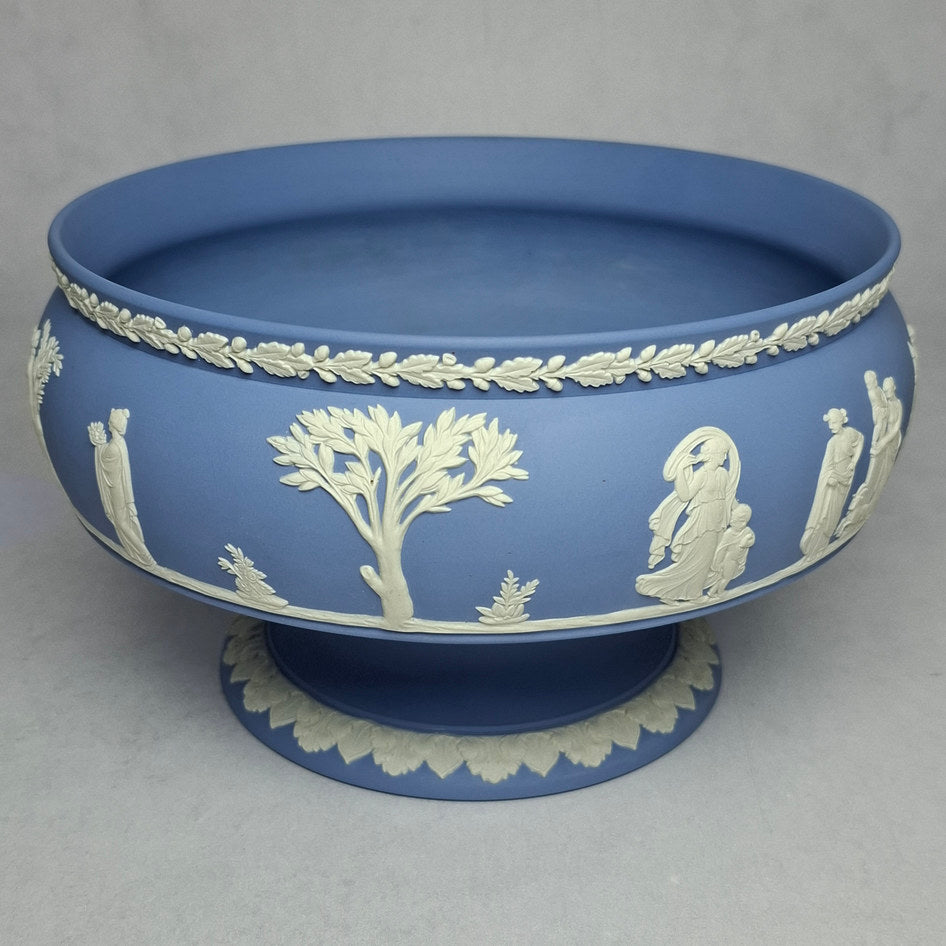
Jasperware is the most iconic Wedgwood product and the one most immediately associated with the Wedgwood name. Developed by Josiah Wedgwood in the 1770s after years of experimentation, Jasperware is a fine stoneware body, not porcelain, characterised by its matte, unglazed surface and the white relief decoration applied against a coloured ground. The classic colour is pale blue, but Josiah Wedgwood developed a range of grounds including sage green, lilac, black, yellow, and the rarer crimson and pink. The white relief decoration, typically depicting classical figures, foliage, and architectural motifs, was applied as a separate layer of white jasper clay before firing.
The standard blue Jasperware is the most commonly encountered colour and the most widely collected. Black Jasperware, known as Black Basalt in its solid form, is a distinct and striking variant. The William Adams and Sons White on Cobalt Blue Jasperware Vase is a related piece from the Adams factory, which was part of the Wedgwood Group from 1966 onward. William Adams and Sons had its own long history of Jasperware production, and Adams pieces are collected alongside Wedgwood proper by collectors who appreciate the broader Jasperware tradition.
Queen's Ware
Queen's Ware is Wedgwood's cream-coloured earthenware, developed by Josiah Wedgwood in the 1760s and named in honour of Queen Charlotte, who appointed Wedgwood as her potter. It is a refined, practical earthenware body that became the foundation of Wedgwood's commercial success and influenced the development of English earthenware production more broadly. Queen's Ware pieces are collected for their historical significance and their clean, elegant aesthetic.
Bone China and Fine Tableware
Wedgwood entered bone china production in the early nineteenth century and has produced a wide range of fine tableware patterns since. The most collected Wedgwood bone china patterns include Florentine, Kutani Crane, Columbia, and the various floral and gilded patterns produced through the twentieth century. Wedgwood bone china is distinguished by its fine, translucent body and the quality of its gilded decoration.
The Lomonosov St Petersburg Cobalt and Gilt Porcelain Cup and Saucer is a related piece from the Russian Imperial Porcelain Factory tradition, representing the cobalt and gilt aesthetic that was influential across European fine china production. Lomonosov pieces are collected alongside English fine china by collectors who appreciate the broader European porcelain tradition.
Commemorative Pieces
Wedgwood produced commemorative pieces throughout its history, marking royal events, historical anniversaries, and significant occasions. These pieces are collected both for their Wedgwood maker interest and for their historical subject matter. The Peter Rabbit calendar plates, produced under licence from Frederick Warne, are among the most widely collected Wedgwood commemorative series in South Africa.
Wedgwood Designers and Artists
Wedgwood has collaborated with significant designers and artists throughout its history. John Flaxman, the neoclassical sculptor, designed many of the most celebrated Jasperware relief subjects in the late eighteenth century. Keith Murray, the New Zealand-born architect and designer, produced a range of modernist Wedgwood pieces in the 1930s that are now actively collected. Eric Ravilious designed the Coronation mug and other pieces in the 1930s and 1940s that are among the most sought-after Wedgwood collector pieces today.
What to Look For When Collecting
The Wedgwood mark has changed over the centuries, and the backstamp is the most reliable starting point for dating and authentication. Key indicators include the presence of "England" in the mark (post-1891), "Made in England" (post-1921), and the three-letter date codes used from 1860 to 1930, which allow precise year dating. The word "Wedgwood" alone, without "and Co" or "and Sons", indicates the genuine Josiah Wedgwood and Sons factory. Pieces marked "Wedgwood and Co" are from a different, unrelated manufacturer.
For Jasperware, assess the quality and sharpness of the white relief decoration, the evenness of the coloured ground, and the condition of the surface. The matte Jasperware body shows fingerprints and surface marks readily, so pieces in clean, undamaged condition are more desirable. For bone china, look at the quality of the gilding, the clarity of the pattern, and the condition of the glaze.
Wedgwood in South Africa
Wedgwood pieces arrived in South Africa in significant quantities through the colonial period and continued to be imported through the twentieth century. Jasperware pieces, particularly blue and white examples, are among the most commonly encountered Wedgwood items at South African estate sales and auction houses. Commemorative and calendar plates, including the Peter Rabbit series, are also regularly found.
Browse the Ceramics collection at Collectibles by Deon for currently available Wedgwood and related pieces, or explore the Blues and Whites collection for blue and white ceramics across makers. For questions about specific pieces or patterns, visit our contact page or learn more about the store.
Frequently Asked Questions
Is Wedgwood Jasperware porcelain?
No. Wedgwood Jasperware is technically a fine stoneware body, not porcelain. It was developed by Josiah Wedgwood in the 1770s and is made from barium sulphate and other materials, fired to produce a dense, matte, unglazed surface. Despite its refined appearance, it is classified as stoneware rather than porcelain.
What is the most valuable Wedgwood Jasperware colour?
Rarity and collector demand vary by period and form, but unusual colourways including black, pink, yellow, and crimson generally command premiums over the standard blue. Older pieces with fine relief quality and documented marks are more valuable than later production in the same colourway.
How do I clean Wedgwood Jasperware?
Wedgwood Jasperware is an unglazed stoneware body that absorbs oils and can stain. Dust with a soft, dry brush. If the surface has become discoloured, a very soft brush dampened with distilled water can be used carefully on the coloured body, avoiding the white relief decoration. Do not use any cleaning products on Jasperware. Read our guide to cleaning antique ceramics for full advice.
How do I date a Wedgwood piece?
Check the backstamp for dating indicators. "England" in the mark indicates post-1891 production. "Made in England" indicates post-1921 production. Three-letter date codes, used from 1860 to 1930, allow precise year dating and are documented in Godden's Encyclopaedia of British Pottery and Porcelain Marks. Read our guide to dating antique ceramics for more detail.
What is the difference between Wedgwood and Wedgwood and Co?
"Wedgwood and Co" and "Wedgwood and Sons" are different companies from Josiah Wedgwood and Sons, the original Wedgwood factory. Pieces marked "Wedgwood and Co" or "Wedgwood and Sons" are not genuine Josiah Wedgwood and Sons pieces. Always verify the exact wording of the mark.
A rewarding category for collectors of Wedgwood Jasperware, British fine ceramics, or decorative collectibles with a documented maker history. Browse the Ceramics collection to explore available pieces, or contact us to ask about specific patterns or colourways.