
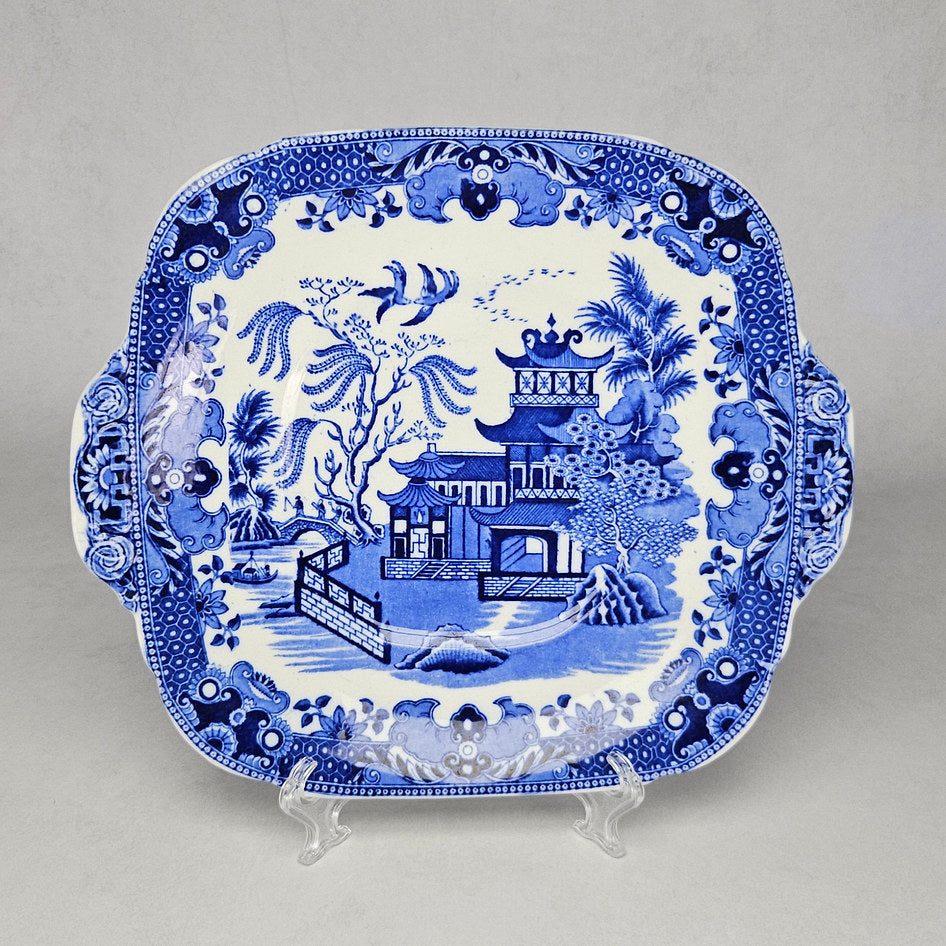
Few ceramic patterns are as instantly recognisable as Blue Willow. A bridge, a willow tree, a pagoda, birds, water, boats and a border of flowing blue decoration have appeared on plates, bowls, platters, jugs and tea wares for more than two centuries. Browse the Blue Willow collection at Collectibles by Deon to see the pieces currently available.
For collectors, Blue Willow is more than a pattern. It is a link between English transferware, Chinese-inspired design, family kitchens, inherited tableware and the long history of blue and white ceramics. At Collectibles by Deon, Blue Willow pieces from different makers and eras can be showcased together because the pattern has been produced by many factories over many generations. Each maker interpreted it slightly differently, which makes collecting Blue Willow both accessible and fascinating.
What is Blue Willow?
Blue Willow is a blue and white transferware pattern used on pottery, earthenware, porcelain and other ceramic tableware. The pattern is usually printed in blue on a white or cream ceramic body. It is inspired by Chinese landscape designs, but the classic Willow pattern as collectors know it today is an English creation. It belongs to the wider tradition of chinoiserie, a European style that interpreted and adapted Asian decorative ideas for Western taste. In the 18th and 19th centuries, Chinese porcelain was highly admired in Europe. British potters responded by creating affordable transfer-printed wares that captured some of the appeal of imported blue and white porcelain. Blue Willow became the most famous of these patterns.
The origins of the Willow pattern
The design is generally associated with late 18th century England. Thomas Minton, Thomas Turner of Caughley, and later Josiah Spode are all important names in the early story. Caughley in Shropshire produced Chinese-inspired blue and white designs in the 1780s. Thomas Minton, who worked as an engraver, is strongly associated with the early development of the pattern. Spode then helped establish and popularise the Willow pattern in Staffordshire around 1790. By the 19th century, many British potteries were producing their own versions. Over time, Blue Willow became one of the most widely recognised and enduring transferware designs in the world.
Why it is called Blue Willow
The name comes from one of the most important features in the design: the willow tree, which usually appears near the bridge and garden scene with long branches bending downward. Although collectors often say Blue Willow, the broader pattern name is simply Willow. It has been made in other colours too, including brown, green, pink, black, red and multicoloured versions. However, blue and white remains the most iconic and most collected colourway.
The main elements of the pattern
A classic Blue Willow design usually includes a willow tree, a bridge with three figures, a pagoda or pavilion, a boat on the water, a fence in the foreground, a garden or island scene, a pair of birds in flight and a decorative border around the edge. Not every maker used the exact same arrangement. Some versions are more detailed, while others are simplified. Some have darker cobalt blue printing, while others are softer or lighter. These variations are part of the collecting interest.
The meaning behind the pattern
The most famous meaning attached to Blue Willow comes from a romantic legend. The story usually tells of Koong-se, the daughter of a wealthy Mandarin, who falls in love with Chang, a young man of lower social position. Her father forbids the match and arranges another marriage. The lovers escape across a bridge, flee by boat and find refuge on an island. In the tragic ending, they are discovered and killed, but are transformed into two birds, often seen flying together above the scene. The bridge, the boat, the pagoda, the fence and the birds are all linked to this story.
It is important to describe this as a legend rather than confirmed ancient history. The story became popular in the 19th century and helped give the pattern emotional appeal. Whether invented as a marketing tale or adapted from older romantic themes, it has become part of the cultural identity of Blue Willow. A plate becomes more than decoration. The viewer can read the design like a picture story, which is one reason the pattern has remained popular for so long.
Transferware and mass production
Blue Willow became popular partly because of transfer printing. Before transfer printing, detailed ceramic decoration was often painted by hand, which was time-consuming and expensive. Transfer printing allowed engraved designs to be printed onto ceramics more quickly and consistently. This made detailed blue and white wares more affordable for middle-class homes. Because of transfer printing, Blue Willow spread widely across Britain and later across the world.
Blue Willow across many makers
One of the most interesting things about Blue Willow is that it was not made by only one factory. Many makers produced Willow pattern and Blue Willow wares, and the Collectibles by Deon collection reflects this variety well. Current pieces include the Churchill Blue Willow English Soup Plate, the Churchill Blue Willow Ceramic Milk Jug, the Churchill Blue Willow Ceramic Sugar Bowl and the Churchill Blue Willow Ceramic Tea Cup and Saucer. From EIT England, the collection includes the EIT England Blue Willow Ceramic Dinner Plate, another EIT England Blue Willow Ceramic Dinner Plate and the EIT England Blue Willow Ceramic Dessert Bowl. Other makers represented include the Royal Doulton Blue Willow Ceramic Milk Jug, the Wood and Sons Woods Ware Willow Blue and White Handled Cake Plate, the Booths Real Old Willow Blue and White Food Warmer Bowl and the Burleigh Ware Willow Blue and White Rectangular Handled Serving Tray.
Each maker's version can differ slightly in colour, border, shape, backstamp, glaze, body and transfer detail. This makes Blue Willow ideal for a mixed collection, where a collector can build a display across makers and eras while still keeping a cohesive blue and white theme.
Antique, vintage and modern Blue Willow
Blue Willow has been made for more than two centuries, so pieces can vary greatly in age. Antique examples may date from the 19th century or early 20th century, often showing older backstamps, heavier earthenware bodies, deeper transfer colours, crazing, age-related wear or older shapes. Vintage examples from the mid 20th century are often easier to find and can be very attractive for display or use. Modern Blue Willow is still produced today. When listing or collecting, it is important to describe the period accurately. Do not call a modern piece antique. Do not call a vintage piece early unless the mark and form support it.
What makes one Blue Willow piece more collectable than another?
Collector appeal depends on several factors. Maker is important, as certain factories are more sought after than others. Age matters when supported by the mark and form. Condition is very important. Unusual shapes can be more desirable. Large platters, tureens, covered dishes, teapots and complete sets often attract attention. Strong transfer colour, clear pattern detail and good backstamps all add appeal. A simple dinner plate may still be attractive, but a large serving piece, early backstamp, unusual maker or excellent condition example may have stronger collector interest.
Condition issues to check
Blue Willow was often used as everyday tableware, so condition should always be checked carefully. Look for chips, cracks, crazing, staining, rim wear, knife marks, glaze loss, discolouration, restoration, hairlines, transfer smudging and foot rim damage. For older pieces, light crazing and age-related wear may be expected. However, cracks, heavy staining, large chips or restoration should always be disclosed. For covered pieces, check that the lid belongs to the base. For serving pieces, inspect handles and rims carefully.
Is Blue Willow rare?
Blue Willow as a general pattern is not rare. It was made in large quantities by many factories over many years. However, specific pieces can be less commonly encountered. Examples that may be more desirable include early pieces, unusual makers, large serving items, complete sets, rare shapes and strong condition examples. The safest wording is usually collectable, desirable, early where supported, less commonly encountered, or sought after by Blue Willow collectors. Use rare only when the specific item has evidence to support that claim.
How to display Blue Willow
Blue Willow is one of the easiest ceramic patterns to display. A single plate can be placed on a stand or hung on a wall. A group of plates can create a striking blue and white wall display. Serving dishes, jugs and bowls can be arranged on open shelving or in a cabinet. Blue Willow pairs well with white ironstone, Delftware, blue and white porcelain, creamware, wooden shelves, brass and copper, vintage kitchenware, floral ceramics, clear glass and other transferware patterns. Because the blue and white palette is so timeless, Blue Willow works in many interiors, from traditional and cottage-style to coastal, farmhouse and modern.
Why Blue Willow belongs in a curated collection
Blue Willow belongs in a curated collection because it connects beauty, history and storytelling. It reflects the European fascination with Chinese-inspired design, the rise of English transferware, the success of mass-produced table ceramics and the lasting appeal of blue and white decoration. It is also deeply approachable. Collectors can enjoy it whether they own one plate or an entire cabinet of mixed pieces.
If you enjoy blue and white ceramics and collector guides, you may also find our articles on Collecting T.G. Green Cornishware Blue and White Kitchen Ware and Aynsley Pembroke Bone China: History, Design and Collector Appeal of interest.
Explore the curated Blue Willow collection at Collectibles by Deon and discover timeless blue and white pieces selected for collectors, decorators and lovers of meaningful ceramic design. For enquiries about specific pieces or availability, visit the Contact page, or learn more about the store on the About page.