
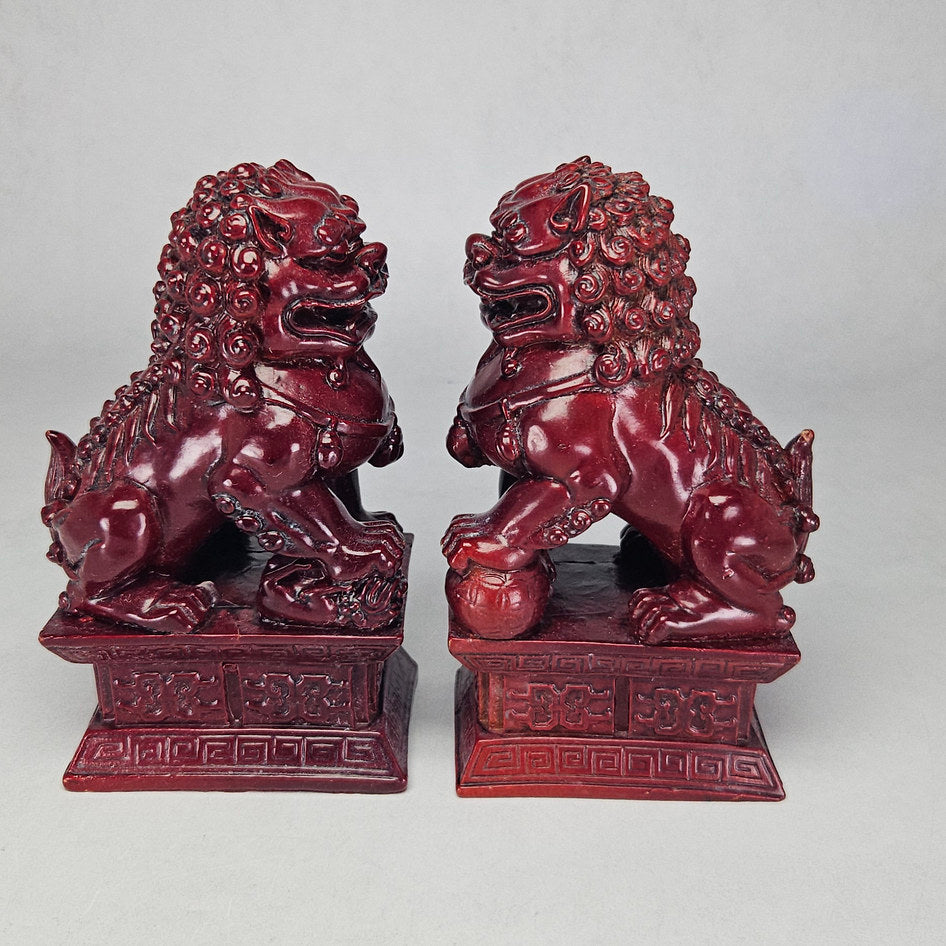
Foo Dogs are among the most recognisable protective figures in Asian decorative art. Fierce, expressive and full of symbolic meaning, they have guarded entrances, temples, homes and important spaces for centuries. At Collectibles by Deon, they are especially rewarding to collect and display because they appear in so many forms, sizes, materials and colours. A single collection can include porcelain, ceramic, resin, cinnabar-style, turquoise-glazed, blue and white, famille rose, metal, stone and modern decorative examples. Browse the Oriental collection to see current pieces.
What are Foo Dogs?
Foo Dogs are guardian lion figures, usually shown seated, alert and powerful, with curled manes, open mouths, strong paws and decorative bases. In traditional display they almost always appear as a pair. The Western name "Foo Dog" is widely used in collecting, but the figures are not technically dogs. The more accurate description is Chinese guardian lions, or Lions of Fo. The name has stayed popular because antique dealers, collectors and decorators have used it for generations, and for product listings it helps to include both terms so pieces are easy to find.
A short history of Chinese guardian lions
The lion was not native to China in the everyday sense, but it entered Chinese visual culture through trade, tribute, Buddhism and contact with regions where lions were known. Over time it became an important protective symbol. Guardian lions were placed at the entrances to temples, tombs, palaces, official buildings and wealthy homes, meant to protect the space, guard against harmful forces and signal status. Early stone guardian lions are known from Chinese tomb contexts, and over the centuries the form developed into the familiar paired entrance lions seen in architecture, sculpture, ceramics and decorative objects. By the Ming and Qing periods they had become highly recognisable symbols. Later, smaller versions were made for homes, collectors and export markets.
Why are they called Lions of Fo?
The term Lion of Fo is linked to Buddhist tradition. In Chinese Buddhist art, lions were associated with protection, strength and the defence of sacred spaces. The lion became a guardian presence, especially at temple entrances, and carries symbolic links to wisdom, courage and authority. In Buddhist contexts it can be connected with the power of teaching and the protection of spiritual truth. This is why guardian lions often appear fierce. Their purpose is not simply decorative. They are meant to guard, protect and command respect.
The meaning of the pair
Foo Dogs are traditionally shown in pairs. The male is usually shown with one paw resting on a ball, often interpreted as a symbol of authority, the world or control. The female is usually shown with a cub under or near one paw, interpreted as a symbol of nurture, family, continuity and protection of life. Together the pair represents balance. One guards outward authority and structure. The other protects the inner life of the home or space. This pairing is part of what makes Foo Dogs so interesting to collectors. A pair is not just two matching ornaments. It is a symbolic set.
How to tell the male and female apart
The easiest way to identify a traditional pair is to look under the paws. The male usually has a ball. The female usually has a cub. In many traditional arrangements the pair is placed at an entrance with the male and female on opposite sides. For collectors displaying smaller decorative pieces indoors, the most important point is simply to keep the pair together and understand the symbolism. Some modern pieces do not follow the traditional details exactly, and others may be made as single decorative figures. These can still be attractive, but a true symbolic pair is usually more appealing to collectors.
Common materials used for Foo Dogs
Foo Dogs have been made in many materials. Traditional large guardian lions were often carved from stone or cast in metal. A beautiful example of the stone tradition is the Hand-Carved Stone Chinese Guardian Lion, which carries the weight and presence of the architectural originals. For those who prefer a metallic finish, the Pair of Bronze-Effect Polyresin Chinese Guardian Lions captures that cast-metal character in a more accessible decorative form. The Pair of Red and Black Cast Stone Chinese Guardian Lions offers a striking two-tone finish that works well in both traditional and contemporary interiors. Ceramic Foo Dogs are especially popular with collectors because they offer colour, glaze, pattern and variety. Common ceramic styles include blue and white porcelain, turquoise-glazed ceramic, famille rose decoration, sancai-style glazing, cinnabar-style red decoration, export porcelain designs, modern decorative ceramic examples and studio pottery interpretations. Each material gives the figure a different character. Stone feels architectural. Porcelain feels refined. Turquoise glaze feels bold and decorative. Cinnabar-style pieces feel rich and ornamental.
Blue and white Foo Dogs
Blue and white Foo Dogs are highly decorative and easy to style. They often feature cobalt decoration on a white ground, sometimes with floral, cloud, scroll, dragon or geometric motifs. These pieces pair beautifully with other blue and white ceramics, including Willow pattern, Delft-style pieces and Chinese export-inspired porcelain. For a related piece that brings the blue and white tradition together with Foo Dog symbolism, the Genuine Ming Blue Floral Porcelain Ginger Jar with Foo Dog Finial is a wonderful example of how guardian lion imagery appears across Chinese decorative arts. For collectors, blue and white Foo Dogs are popular because they are both symbolic and visually versatile. They sit comfortably in traditional interiors, coastal schemes, modern shelving or dedicated blue and white ceramic displays.
Turquoise-glazed Foo Dogs
Turquoise-glazed Foo Dogs have a striking presence. The colour is bright, bold and closely associated with Chinese ceramic taste, ranging from soft blue-green to vivid jewel-like tones. These pieces are popular because they stand out immediately. A pair of turquoise Foo Dogs can act as strong bookends, cabinet pieces or mantel display objects. The Chinese Turquoise Glazed Porcelain Foo Dog Statue is a fine example of this style, with its vivid glaze and expressive modelling. When describing turquoise pieces, focus on the visible glaze, form, size, condition and mark if present. Avoid assigning a dynasty or early period unless the evidence supports it.
Cinnabar-style and red Foo Dogs
Red Foo Dogs, especially cinnabar-style examples, are popular for their rich colour and carved-looking surfaces. True carved cinnabar lacquer is a specific and historically important technique, but many modern decorative pieces are cinnabar-style rather than genuine antique lacquer. The Pair of Chinese Red Cinnabar-Style Resin Foo Dog Figurines is a strong example of this style, with deeply textured surfaces and rich red colouring that makes an immediate impression. For a lacquered finish with a slightly different character, the Pair of Red Lacquered Chinese Guardian Lions offers a glossy, bold alternative. These pieces are still highly decorative and attractive, especially for collectors who enjoy bold red colour, Asian-inspired design and detailed surface pattern.
Chinese dragons and related guardian figures
The dragon is the most powerful symbol in Chinese decorative art, representing imperial authority, strength, good fortune and protection. Unlike the Western dragon, the Chinese dragon is a benevolent figure, associated with water, rain, prosperity and the emperor. Decorative dragon figures appear across a wide range of materials and periods. The collection includes the Chinese Fiery Red Lacquered Resin Dragon Statue, the Large Vintage Gilded Resin Chinese Feng Shui Dragon Statue with Orb Detail, the Large Vintage Gilded Resin Feng Shui Dragon with Raised Orb on Base, and the Pair of Chinese Gilded Resin Dragons with Orbs. For collectors who appreciate hand-carved examples, the Antique Hand-Carved Rosewood Dragon Incense Burner Sculpture and the Antique Hand-Carved Wooden Water Dragon Incense Burner Sculpture represent the craft tradition of carved wooden dragon objects. The Vintage Hand-Painted Folding Hand Fan with Dual Dragon Motif shows how the dragon appears across decorative objects beyond sculpture.
Terracotta warriors and Chinese figurative sculpture
The terracotta warriors of the Qin dynasty are among the most celebrated archaeological discoveries of the twentieth century. Decorative reproductions of these figures have become popular collector pieces in their own right, valued for their historical reference and strong sculptural presence. The collection includes a range of terracotta warrior figures: the Vintage Chinese Terracotta Warrior Statue, the Standing Warrior Statue, the Helmeted Standing Warrior Statue, the Officer Warrior Statue, and the Kneeling Warrior Statue, each representing a different rank and posture from the original burial army. The Vintage Japanese Samurai Kabuto Cast Iron Helmet is a related piece from the Japanese warrior tradition, appealing to collectors who appreciate Asian military history and decorative armour.
What makes Foo Dogs collectable?
Foo Dogs are collectable for several reasons. They carry strong symbolism, they are visually powerful, they come in many materials and colours, and they display well in pairs. They connect to Chinese art and architecture, suit both traditional and modern interiors, and can be collected by size, colour, material or style. For many collectors the attraction is not only decorative. Foo Dogs carry a sense of protection, balance and presence. They feel meaningful in a home. A pair can add structure to a shelf, frame a doorway, anchor a cabinet display or sit as statement pieces on a console table. Collectors who enjoy related guardian figures may also find the Pair of Chinese-Style Resin Qilin Pixiu Guardian Statues of interest, as Qilin and Pixiu are closely related protective figures in Chinese decorative tradition. Browse the Oriental collection or explore Figurines to see current examples.
What to look for when collecting Foo Dogs
Start by checking whether the piece is a pair or a single figure. Pairs are often more desirable, especially if the male and female details are present. Check whether one has a ball and the other has a cub. Next, examine the material. Is it porcelain, ceramic, resin, metal, stone or another material? The material affects value, weight, age and collector appeal. Then look at the decoration. Hand-painted detail, strong glaze colour, crisp moulding, balanced expression and good surface quality all add to display appeal. Also inspect the base. Some pieces may have marks, stamps, labels or country of origin details. Others are unmarked. A mark can help with dating and identification, but many decorative Foo Dogs are not marked.
Condition details to check
Condition is important, especially with ceramic and porcelain Foo Dogs. Check for chips, cracks, restoration, glaze loss, missing ears, damaged paws, broken tails, cracked bases, paint loss, heavy surface wear, repairs to cubs or balls, and damage to raised decoration. The ears, teeth, paws, tails and base corners are often the most vulnerable areas. For pairs, check that both pieces match in size, colour, glaze and decoration. A mismatched pair can still be decorative, but it should be described honestly.
Antique, vintage or modern?
Foo Dogs have been made for a very long time, and many modern examples are produced today. Age should therefore be described carefully. A piece should only be called antique if there is supporting evidence, such as a reliable mark, documented provenance, age-consistent materials and construction, or expert identification. Many pieces are better described as vintage, decorative, modern, Chinese-style, export-style or contemporary. Safe wording includes: Chinese guardian lion figure, Foo Dog style, vintage ceramic Foo Dog, decorative porcelain Foo Dog pair, Chinese-style guardian lions, or modern decorative guardian lion pair. This keeps descriptions accurate and trustworthy.
Are Foo Dogs rare?
Foo Dogs as a general category are not rare. They have been made in many forms for many markets. However, some examples are less commonly encountered, including large older pairs, finely carved stone examples, early porcelain figures, unusual glazes, signed studio pieces, antique architectural examples, documented export pieces or pairs in excellent condition. For most product descriptions, use careful wording such as collectable, decorative, striking or less commonly encountered, and reserve the word rare only where evidence supports the claim.
Why people love collecting Foo Dogs
People collect Foo Dogs because they combine meaning and beauty. They are protective symbols, but they are also decorative sculptures. They can feel serious, playful, fierce, elegant or colourful depending on the style. Some collectors love the symbolism. Others love the colours and glazes. Some collect them as part of a wider Oriental ceramics display. Others use them in interior styling because pairs of guardian lions create balance and visual strength. They also appeal because they can be collected gradually. A collector may begin with one blue and white pair, then add turquoise, red, famille rose, metal or smaller cabinet examples over time.
How to style Foo Dogs at home
Foo Dogs are excellent for display. A pair can be placed on either side of a shelf, doorway, mantel, console table or cabinet. Smaller pairs work well as bookends or beside ceramics, books and framed art. The Gold-Lacquered Polyresin Chinese Guardian Lion works particularly well as a statement mantel piece, while the Bronze-Effect Polyresin pair suits darker, more masculine interiors with wood and metalware. They pair naturally with blue and white ceramics, Chinese porcelain, Delft-style ceramics, brass and metalware, dark wood, lacquer-style objects, Oriental porcelain, jadeite-style glass, red decorative accents and botanical arrangements. For a strong collector display, group Foo Dogs by colour or material. A blue and white grouping feels classic, while turquoise pieces create a bold statement. Explore the Ceramics collection for complementary pieces to build around them.
Why a Foo Dog collection is worth showcasing
A Foo Dog collection tells a layered story. It connects Chinese guardian symbolism, Buddhist protective imagery, architectural tradition, ceramic art, export taste and modern collecting. A varied collection allows visitors to see the range within the category. Not all Foo Dogs look the same. Some are fierce and formal. Some are colourful and playful. Some are elegant porcelain pieces. Others are bold decorative statements. This variety makes them a strong subject for the blog, with natural opportunities to link pieces by colour, material, pair, size or style.
Why Foo Dogs remain special
Foo Dogs are more than ornaments. They are guardians, symbols and sculptural objects. They bring a sense of strength, balance and tradition into a space. Their long history gives them cultural depth, while their many colours and materials make them highly decorative. For collectors they offer variety and meaning. For decorators they bring structure and presence. For those who enjoy symbolic objects, they carry the idea of protection and guardianship. A well-chosen pair can become one of the most distinctive features in a collection.
Explore the curated Oriental collection and Figurines at Collectibles by Deon, and discover symbolic, decorative and highly displayable pieces selected for collectors, decorators and lovers of meaningful design. See what is new in the latest arrivals, or contact us with any enquiries. Learn more about the store and how each piece is sourced.