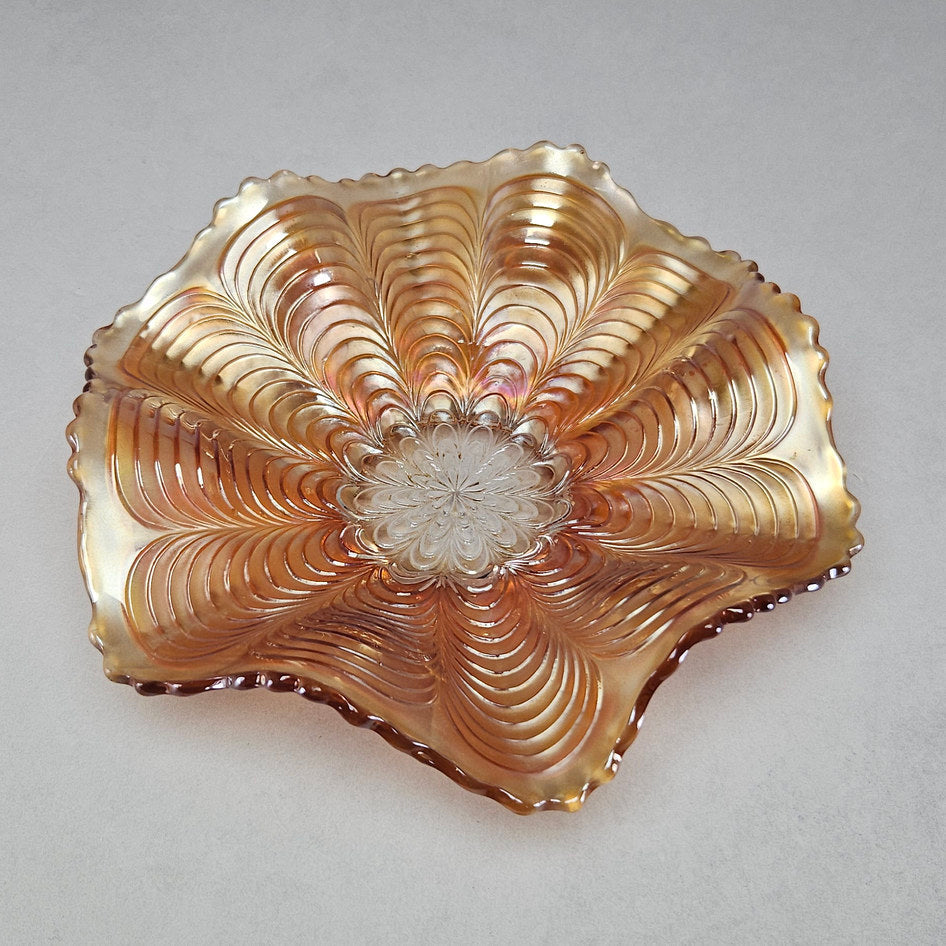
Carnival Glass is a type of iridescent pressed glass produced primarily between 1905 and the early 1930s. It is made by spraying metallic salts onto hot glass before firing, which creates the characteristic rainbow-like surface sheen that collectors prize. Despite its glamorous appearance, it was manufactured as affordable glassware for the mass market, and it is this combination of accessibility and beauty that made it one of the most widely collected categories of antique glass in the world.
The name "Carnival Glass" is a modern collector's term. During its original production era, manufacturers marketed it under names such as "Iridill" (Fenton), "Aurora" (Northwood), and simply "iridescent ware." The "Carnival" label emerged decades later, reflecting the popular belief that unsold stock was given away as prizes at travelling fairs and carnivals in the United States. This origin story, while widely repeated, is difficult to verify with documentary evidence and is best treated as collector folklore rather than established fact.
How Carnival Glass Is Made
The iridescent effect is achieved through a specific production process. Molten glass is pressed into a patterned mould to create the raised decorative design. While the piece is still hot, a metallic salt solution, typically containing compounds of iron, tin, or bismuth, is sprayed onto the surface. The heat causes the salts to bond with the glass, producing a thin metallic film that refracts light and creates the iridescent sheen. The colour of the base glass determines the overall tone: marigold (amber-orange) is the most common, followed by green, blue, purple/amethyst, and the rarer smoke, red, and ice blue or ice green variants.
The Key American Makers
The American pressed glass industry dominated Carnival Glass production, and four manufacturers account for the majority of pieces found in collections today.
Fenton Art Glass Company (Williamstown, West Virginia) is widely credited as the first commercial producer of iridescent pressed glass in the United States, beginning production around 1907. Fenton patterns represented in the Collectibles by Deon Carnival Glass collection include the Holly compote, Orange Tree bowl, Peacock and Urn bowl, Sailboats bowl, and Butterfly and Berry footed bowl, all well-documented Fenton patterns with established collector references. Fenton also produced the Little Flowers pattern, found here in the blue iridescent Little Flowers berry bowl. The Peacock Tail marigold square crimped bowl is a further Fenton pattern, characterised by its distinctive fan-like moulded design.
Imperial Glass Company (Bellaire, Ohio) was one of the largest producers of Carnival Glass and is known for bold, geometric patterns and strong colour saturation. Imperial pieces in the collection include the Windmill ruffled bowl, the Morning Glory vase in smoke, the Beaded Bullseye marigold swung vase, the Ripple marigold swung vase, the Floral and Optic marigold footed bowl, the Star and File marigold ruffled bowl, the Heavy Grape amber handled sweet dish, and the Diamond Lace green creamer, a less common Imperial colour. The Green Grape tumbler illustrates Imperial's use of the grape motif across multiple forms. Imperial used a distinctive "Iron Cross" mark on some pieces, though many were left unmarked.
Northwood Glass Company (Wheeling, West Virginia) is particularly prized by collectors for the quality of its iridescence and the crispness of its mould work. Harry Northwood, who founded the company, introduced a distinctive underlined "N" mark on many pieces, one of the few Carnival Glass makers to mark production consistently. The Fruits and Flowers bonbon dish in blue, represented in this collection, is a documented Northwood pattern.
Dugan Glass Company (Indiana, Pennsylvania), later reorganised as Diamond Glass Company, produced a wide range of patterns. The Fishscale and Beads ruffled bowl is a documented Dugan design, typically found in marigold and peach opalescent.
European Production: Joseph Inwald
While American makers dominate the Carnival Glass canon, European production is less widely documented but equally legitimate. Joseph Inwald operated glassworks in Bohemia (present-day Czech Republic) and produced iridescent pressed glass for export markets from the early twentieth century. Two Inwald pieces in the Carnival Glass collection, the Coronet Princeton pattern vase and the Laurier Nelly pattern pedestal vase, are documented in specialist Carnival Glass references including the work of researchers Monica Clements and Patricia Bingham, who have catalogued European Carnival Glass production in detail. Inwald pieces are less common in South African collections than American examples and represent a genuine point of difference for the serious collector.
Beyond the named makers, the collection also includes earlier iridescent pressed glass pieces that predate the Carnival Glass era proper. The amber iridescent pressed glass sweet bowl and the Fairfield-style amber pressed glass vase are examples of the broader iridescent pressed glass tradition from which Carnival Glass emerged.
Colours and Rarity
The colour of a Carnival Glass piece is determined by the base glass, not the iridescent spray. As a general guide based on established collector consensus:
- Marigold: the most common colour; amber base glass with orange-gold iridescence
- Green: produced by most major makers; typically shows gold or bronze iridescence
- Blue: less common than marigold or green; shows a blue-to-purple iridescence
- Amethyst/Purple: a rich purple base; highly collectable
- Smoke: a grey-toned base with silver iridescence; less common, particularly in Imperial
- Amber: distinct from marigold; a deeper, browner base tone
- Red: genuinely rare and commands significant premiums; not represented in this collection
- Ice Blue / Ice Green: pale, pastel base colours; rare and sought-after
What to Look For When Collecting
Pattern identification is the foundation of Carnival Glass collecting. The raised moulded pattern is pressed into the glass before iridising, so the design is structural, not painted. Reputable references for pattern identification include the Standard Encyclopedia of Carnival Glass by Bill Edwards and Mike Carwile, which is the most widely used collector reference in the field.
Key points to assess when examining a piece:
- Mould sharpness: crisp, well-defined pattern relief indicates quality pressing and an early or well-maintained mould
- Iridescence quality: look for depth and colour shift across the surface; flat or thin iridescence may indicate later or lower-quality production
- Condition: chips, cracks, and mould roughness affect value significantly; examine the ruffled edges carefully as these are the most vulnerable points
- Base colour: hold the piece up to natural light to assess the true base glass colour, which determines rarity
- Maker identification: Northwood's underlined "N" mark is the most reliable maker's mark; Imperial's Iron Cross mark appears on some pieces; most Fenton and Dugan pieces are unmarked and must be identified by pattern
Carnival Glass in South Africa
Carnival Glass reached South Africa primarily through British import channels during the early twentieth century, as well as through household goods brought by settlers and immigrants. American Carnival Glass was exported widely to Britain and the Commonwealth from the 1910s onward. As a result, marigold pieces, the most heavily exported colour, are the most commonly encountered in South African collections and at local auction houses and antique dealers. Blue, green, and smoke examples are less frequently seen and tend to attract stronger interest when they do appear.
The Collectibles by Deon Carnival Glass collection includes examples from the principal American makers, Fenton, Imperial, Dugan, and Northwood, as well as the rarer European production of Joseph Inwald, offering collectors in South Africa access to a well-documented cross-section of the category. You are also welcome to browse all crystal and glass or read more about collecting glassware and art glass collecting in South Africa. For enquiries about specific pieces, visit our contact page or learn more about the store.
Frequently Asked Questions
What makes Carnival Glass iridescent?
The iridescence is created by spraying metallic salt compounds onto the surface of hot pressed glass before firing. The salts bond with the glass and form a thin metallic film that refracts light, producing the characteristic rainbow sheen.
Is all Carnival Glass American?
No. While American manufacturers, particularly Fenton, Imperial, Northwood, and Dugan, dominated production, European makers including Joseph Inwald in Bohemia and others in Britain and Australia also produced iridescent pressed glass during the same period.
How do I identify the maker of a Carnival Glass piece?
Northwood is the most reliably marked maker, using an underlined "N" on many pieces. Imperial used an Iron Cross mark on some production. Most Fenton and Dugan pieces are unmarked and are identified by pattern, which can be cross-referenced against established collector references such as the Standard Encyclopedia of Carnival Glass by Edwards and Carwile.
What is the most common Carnival Glass colour?
Marigold, an amber-orange base glass with gold iridescence, is by far the most commonly produced and encountered colour. It was the primary export colour and the most widely distributed internationally.
What does "ruffled" mean in Carnival Glass?
Ruffled refers to the edge treatment of bowls and dishes, where the rim is crimped and fluted into a wavy, ruffled shape while the glass is still hot and pliable. It is one of several standard edge treatments used by American Carnival Glass makers.
Is Carnival Glass still being made?
Yes. Fenton Art Glass produced both original and reproduction Carnival Glass pieces until the company ceased production in 2011. Other manufacturers have produced Carnival-style glass since the original era. When collecting, it is important to distinguish between original early twentieth-century production and later reproductions, which are generally lighter in weight and less crisply moulded.
A rewarding category for collectors of Carnival Glass collection, early twentieth-century decorative arts, or iridescent pressed glass with documented maker provenance. To explore available pieces, visit the Carnival Glass collection, or contact us to ask about specific patterns or makers.